


When someone asks me for an industrial marketing strategy, what they usually mean is “we need more leads”. Sometimes it’s “our website is embarrassing”. Both are fair. But neither is a strategy, and jumping straight to tactics is how companies end up with a new website that looks great and still doesn’t bring in the right people.
Industrial products are sold on specs, trust and uptime. The buyers are engineers, quality managers and procurement teams, and they take their time. So a marketing strategy for industrial products has to start somewhere else: with applications, buyers and proof. Channels come later.
Below is the process I use, in eight steps. It’s not complicated, but most of the work is in the first four, and that’s exactly the part people like to skip.
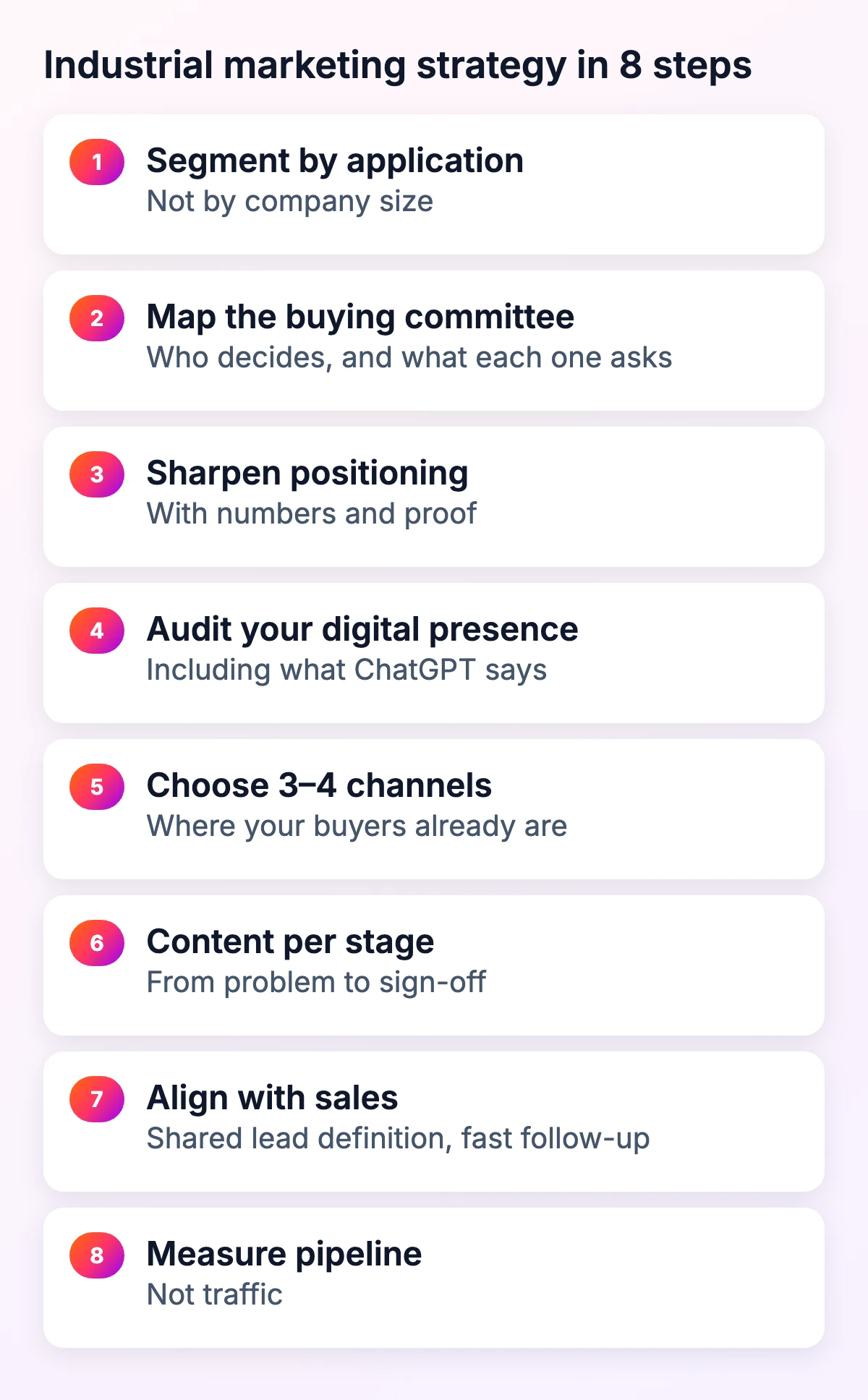
The short version: work out which applications you want to win and who decides, give each of those people the proof they need, and measure everything in pipeline. Then pick your channels.
What is industrial marketing?
Industrial marketing is marketing by companies that sell to other businesses in industry: manufacturers of machinery, components, ingredients, packaging or processing technology. Its job is to help technical buyers find, understand and choose a supplier, in buying processes that are long and involve several people.
What’s being sold varies a lot. Raw materials and ingredients, components that go into someone else’s product, equipment and production lines, and the maintenance, repair and spare parts that keep it all running. Each one is bought slightly differently, but the basics below apply to all of them.
How it differs from other B2B marketing
A lot of B2B marketing advice is written with software companies in mind. Some of it carries over. Quite a lot doesn’t.
| Typical B2B (e.g. SaaS) | Industrial | |
|---|---|---|
| Sales cycle | Weeks to a few months | Six to eighteen months, often with samples or trials |
| Who decides | A team lead and a budget holder | Engineering, procurement, quality, operations and finance |
| What they look for | Features, price, ease of use | Specs, compliance, reliability, service, total cost |
| Where they look | Review sites, social, free trials | Search, supplier websites, trade shows, colleagues, distributors |
| What convinces them | A good demo | Proof: data sheets, references, test results, a visit |
The biggest difference is the last row. Industrial buyers are careful because a wrong decision can stop a production line. They need to be able to defend their choice internally, so your job is to give them the evidence to do that.
Industrial marketing strategy in 8 steps
1. Segment by application, not by company size
Most companies segment by size or region because that’s what the CRM can do. In industry, what customers do with your product matters more. A food equipment maker selling into dairy, bakery and ready meals has three different markets: different regulations, different problems, different words in Google.
Pick the two or three applications where you win most often, or with the best margins. That’s where you start. You can always add more later.
2. Map the buying committee
For each application, write down who’s involved in a typical purchase and what each person worries about. The engineer wants to know if it fits the line. Procurement cares about price, lead times and supplier risk. Quality wants certificates. The plant manager thinks about installation and downtime. Finance wants to know when it pays for itself.
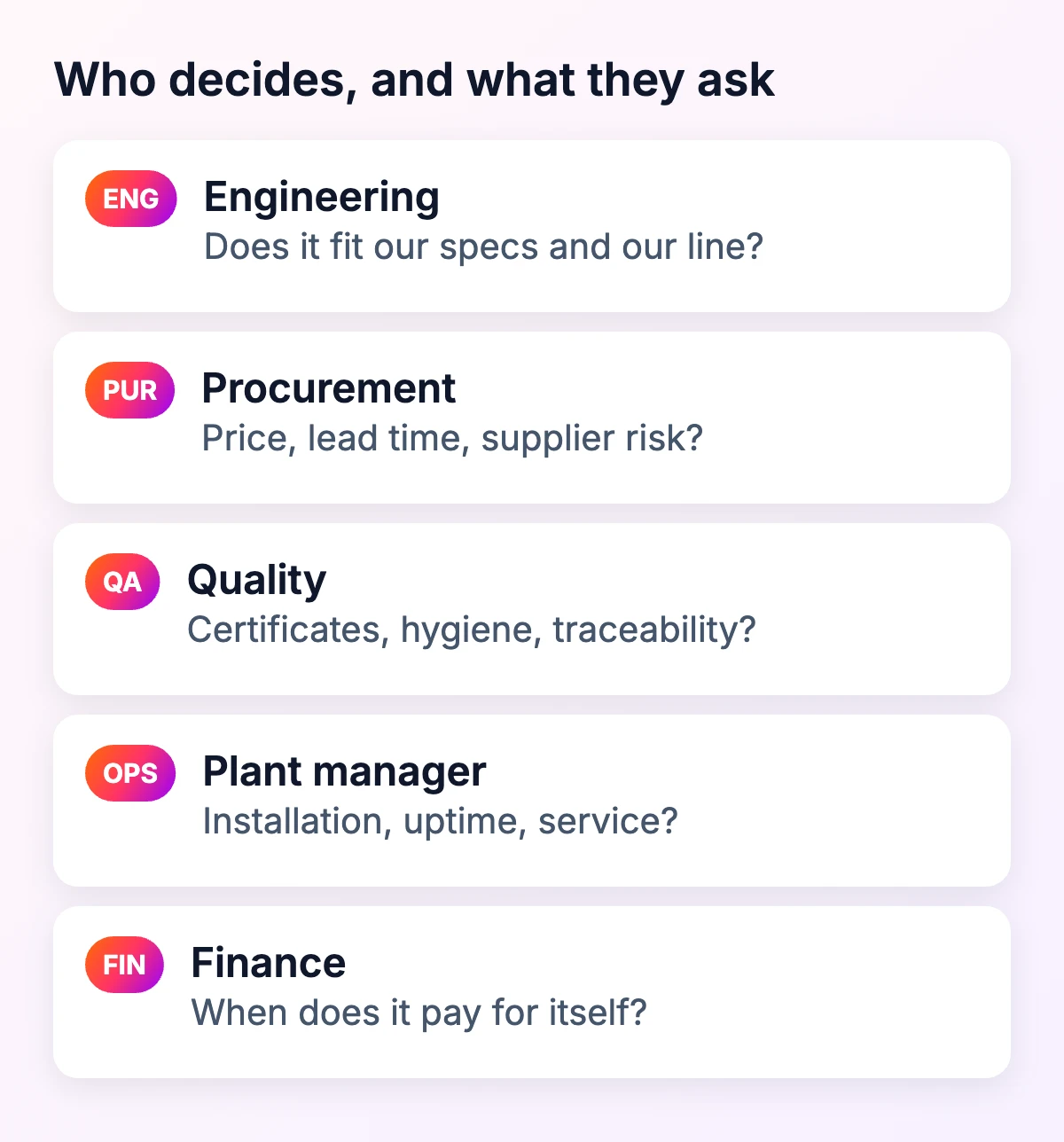
Most manufacturer websites only answer the engineer. If you’re curious how these people actually research suppliers, I wrote about it in how engineers and procurement teams research suppliers online.
3. Sharpen your positioning, with proof
This is where I see the most common mistake: talking about the product instead of the problem it solves. Manufacturers know their products inside out, so the messaging gets very technical very quickly. But the buyer is still asking: is this relevant to me, why is it better, and why should I trust you?
Good industrial positioning is concrete. Cleaning time down from four hours to ninety minutes. Yield up 3%. Service engineer on site within 24 hours anywhere in Spain. If you have numbers like that, they belong at the top of your website, not on page 14 of a brochure.
4. Audit your digital presence
Before deciding what to do, look honestly at where you are. Can buyers find you when they search for the problems you solve? Is your product data complete, current and easy to download? Do your case studies have actual numbers in them? What does your LinkedIn company page say about you?
And one newer check: ask ChatGPT what it knows about your company and your category. More and more buyers do exactly that to build a first shortlist. If the answer is vague, or worse, it names your competitors, that tells you something. I explain how to improve that in how to get your B2B company recommended by ChatGPT and AI search.
Want an outside view? We can look at your digital presence next to your three main competitors and tell you where the gaps are. Get in touch.
5. Choose your channel mix
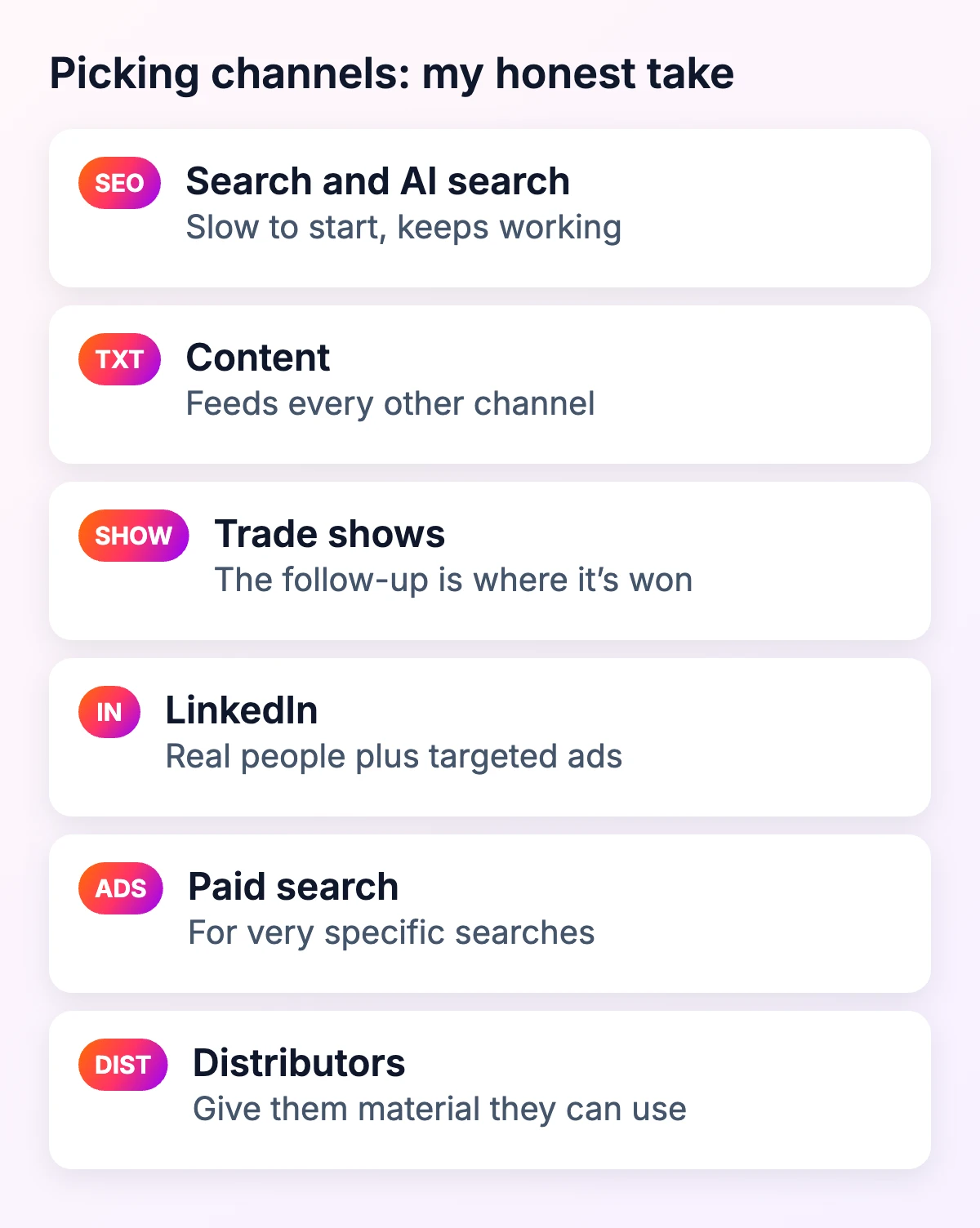
Only now do you pick channels. You don’t need all of them. Most industrial companies do best with three or four, and the right ones depend on where your buyers spend time and how long they take to decide. My honest take on the usual options:
- SEO and AI search. Slow to start, but it keeps working. Engineers search for very specific things, and if you answer them well you’ll get exactly the right visitors. More in SEO for food processing and packaging equipment suppliers.
- Content. Application notes, case studies, comparison pages. It feeds every other channel, so it’s rarely wasted.
- Trade shows. Still one of the best ways to meet buyers. The show itself is only half the job, though; the follow-up is where most of the value is won or lost. See following up on trade show leads.
- LinkedIn. Works best with real people posting, plus targeted ads to specific job titles or company lists.
- Paid search. Good for very specific searches: product types, applications, spare parts. Judge it on cost per qualified lead.
- Distributor co-marketing. If you sell through partners, give them content, product data and campaigns they can actually use. They’re part of your marketing whether you plan for it or not.
Inbound or outbound? Usually both. Inbound (search, content) brings in people who are already looking. Outbound (targeted LinkedIn, direct outreach, pre-booked meetings at shows) reaches the accounts you really want before they start looking.
6. Build content for each stage of the decision
Think about what a buyer needs at each point. Early on: help understanding the problem and the options. Then: proof that you can solve it for someone like them. Right before deciding: everything procurement, quality and finance need to sign off.
In practice, that’s application guides and comparison pages early, case studies and short videos of equipment actually running in the middle, and spec sheets, CAD files, ROI or TCO calculators and references at the end. One small tip: listen to the questions that come up again and again at trade shows. They’re often your next best article.
7. Align marketing with sales (and distributors)
This is where a lot of industrial marketing falls apart. Marketing generates leads, sales says they’re rubbish, and nobody changes anything. Sit down together and agree what a good lead looks like: application fit, company size, region, timing.
And be careful with volume. I’ve seen a company come back from a trade show with more than 200 leads, and once the list was cleaned up only a small share were relevant prospects. Then make sure good leads are followed up quickly. Research published in Harvard Business Review found that companies contacting leads within an hour were far more likely to qualify them than companies that waited. I go deeper into this in lead generation for manufacturers.
8. Measure pipeline, not traffic
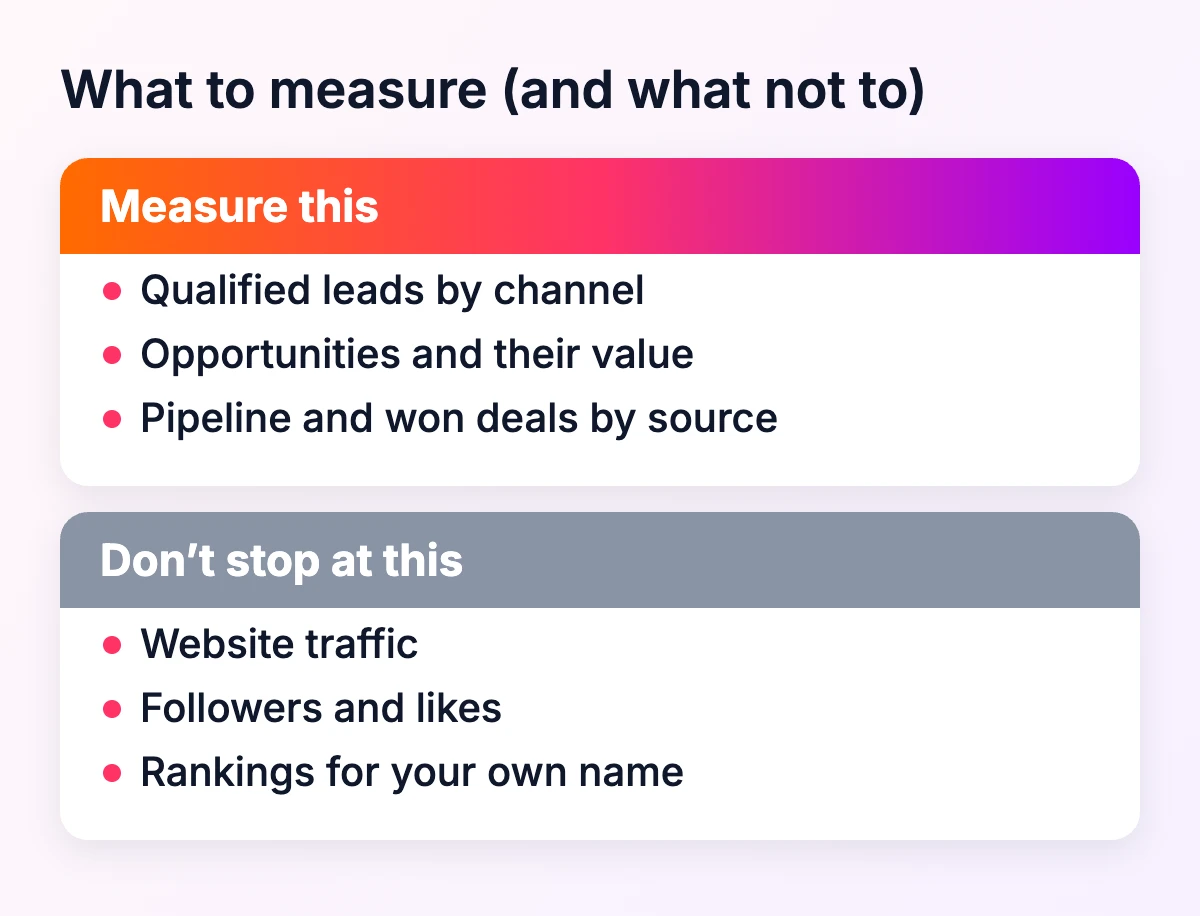
Traffic and followers are nice. They’re not the point. The numbers that matter are qualified leads, opportunities, their value, and where they came from. That means connecting your website analytics, forms and CRM, which takes a bit of setup but changes the conversation with management completely.
I’m always a little careful saying SEO “won” a deal, because in B2B there are usually several touchpoints before someone buys. But for one food technology company, SEO-led content, expert interviews and better landing pages increased organic visibility by 68% in nine months. More importantly, they started showing up for the specific technical problems their customers were searching for.
Lot, Lum Collective
You can read the full story in the food tech SEO case study.
What this looks like in practice
To make it concrete, here’s a made-up but very typical example: a mid-sized manufacturer of hygienic processing equipment, selling mostly in Europe.
- Segments: they focus on two applications, dairy and plant-based drinks, because that’s where their cleaning-time advantage matters most.
- Buying committee: process engineers, QA managers, plant managers and procurement. Finance joins for anything over a certain budget.
- Positioning: “Shorter cleaning cycles, validated to EHEDG guidelines”, backed by test data and two customer references.
- Audit: the website has one generic product page per machine and the spec sheets sit behind a form. ChatGPT doesn’t mention them at all.
- Channels: SEO and content around cleaning and hygienic design, two trade shows a year with a proper follow-up plan, and LinkedIn aimed at QA and process engineers.
- Content: an application page for each segment, a guide to reducing CIP time, two case studies with numbers, and spec sheets anyone can download.
- Sales alignment: agreed lead criteria, CRM routing by region, and a 48-hour follow-up rule after shows.
- Measurement: qualified leads and pipeline per segment, reviewed with sales every month.
None of that is revolutionary. That’s kind of the point. Most of the gains come from doing the basics properly and consistently.
Mistakes I see a lot
- Leading with the product catalogue instead of the applications and problems you solve.
- Putting spec sheets and basic technical information behind a form. If someone is seriously considering you, that’s just friction.
- Spending a fortune on a trade show and almost nothing on what happens before and after.
- Marketing and sales measured on different numbers, so nobody agrees on what’s working.
- Trying to do every channel at once, and none of them properly.
Where to start
If this feels like a lot, start with steps 1 to 3. Pick your applications, map who decides, and rewrite your main pages around the problems you solve, with proof. That alone will make your website, your sales conversations and your trade show stand better. When you’re ready to put it on paper, this one-page manufacturing marketing plan template helps.
For the bigger picture, including the channels in more detail, have a look at our guide to marketing for manufacturing companies. And if you work in food tech, here’s how we work with food tech companies.
Frequently asked questions
Industrial marketing is marketing by companies that sell to other businesses in industry, such as manufacturers of machinery, components, ingredients or packaging. It helps technical buyers find, understand and choose a supplier in long buying processes with several people involved.
Start by segmenting by application, mapping the buying committee and sharpening your positioning with real proof. Then focus on three or four channels your buyers actually use, such as SEO and content, trade shows with good follow-up, and LinkedIn, and measure everything in pipeline.
Make your website answer the questions of every person involved in the purchase: application pages, downloadable spec sheets, case studies with numbers and a clear way to ask for a quote or sample. Then bring the right people there with SEO, content and targeted LinkedIn campaigns.
There are far fewer buyers, purchases are larger and more rational, several people decide together, and the sales cycle can take months or years. Proof and trust matter much more than brand awareness or emotional campaigns.
Outbound activity, trade show follow-up and paid campaigns can start conversations within weeks. SEO and content usually take six to twelve months to build up. Plan for at least a year and review progress every quarter.