

By the time a technical buyer contacts you, most of their research is already done. They’ve read your website, compared you with a few competitors, downloaded a data sheet or two and probably asked colleagues what they think. Sometimes they’ve already decided who’s on the shortlist.
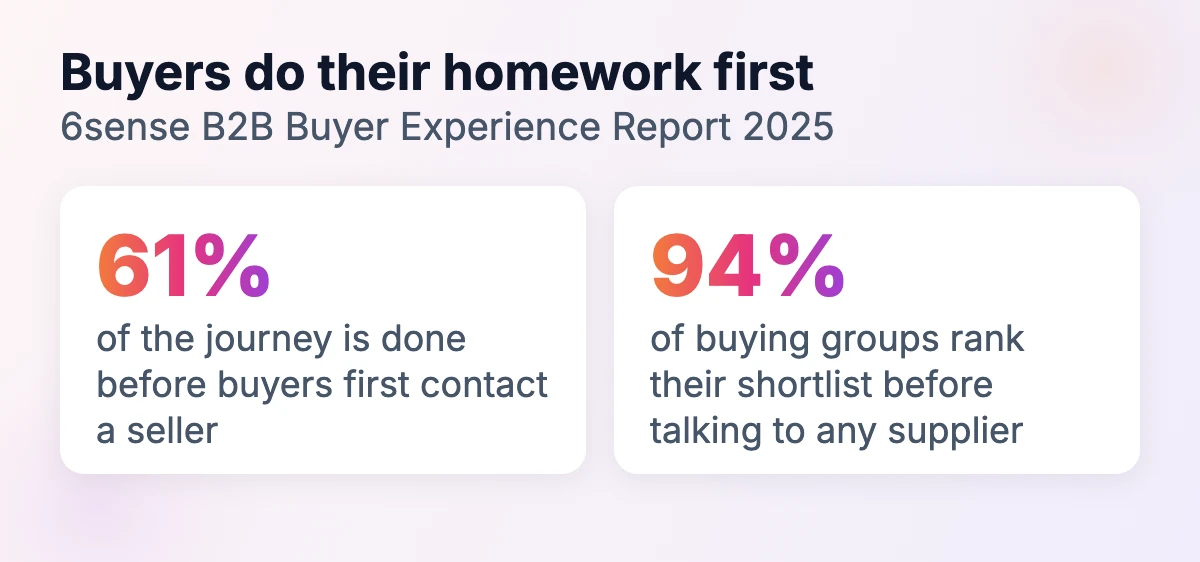
The numbers back this up. The 6sense B2B Buyer Experience Report 2025 found that buyers first reach out to a seller about 61% of the way through their buying journey, and that 94% of buying groups rank their shortlist before speaking to any supplier. Gartner’s research on the B2B buying journey points the same way: about three in four B2B buyers would rather buy without a sales rep at all.
So the question isn’t whether your buyers research you online. It’s whether they find what they need when they do.
In a technical B2B purchase, several people research you separately, each with their own questions. Your website and content need an answer for each of them, long before anyone fills in a contact form.
More than one person decides
In industries like food processing, manufacturing, IT and connectivity, a purchase is rarely one person’s decision. A typical buying group looks something like this:
- The engineer or technical lead checks whether your solution actually works: specs, integration, performance, standards.
- Operations or production wants to know about installation, downtime, maintenance and support.
- Procurement compares suppliers on price, terms, delivery times, references and risk.
- Management or finance looks at the business case: payback, total cost and strategic fit.
- End users care about whether it’s easy to work with every day.
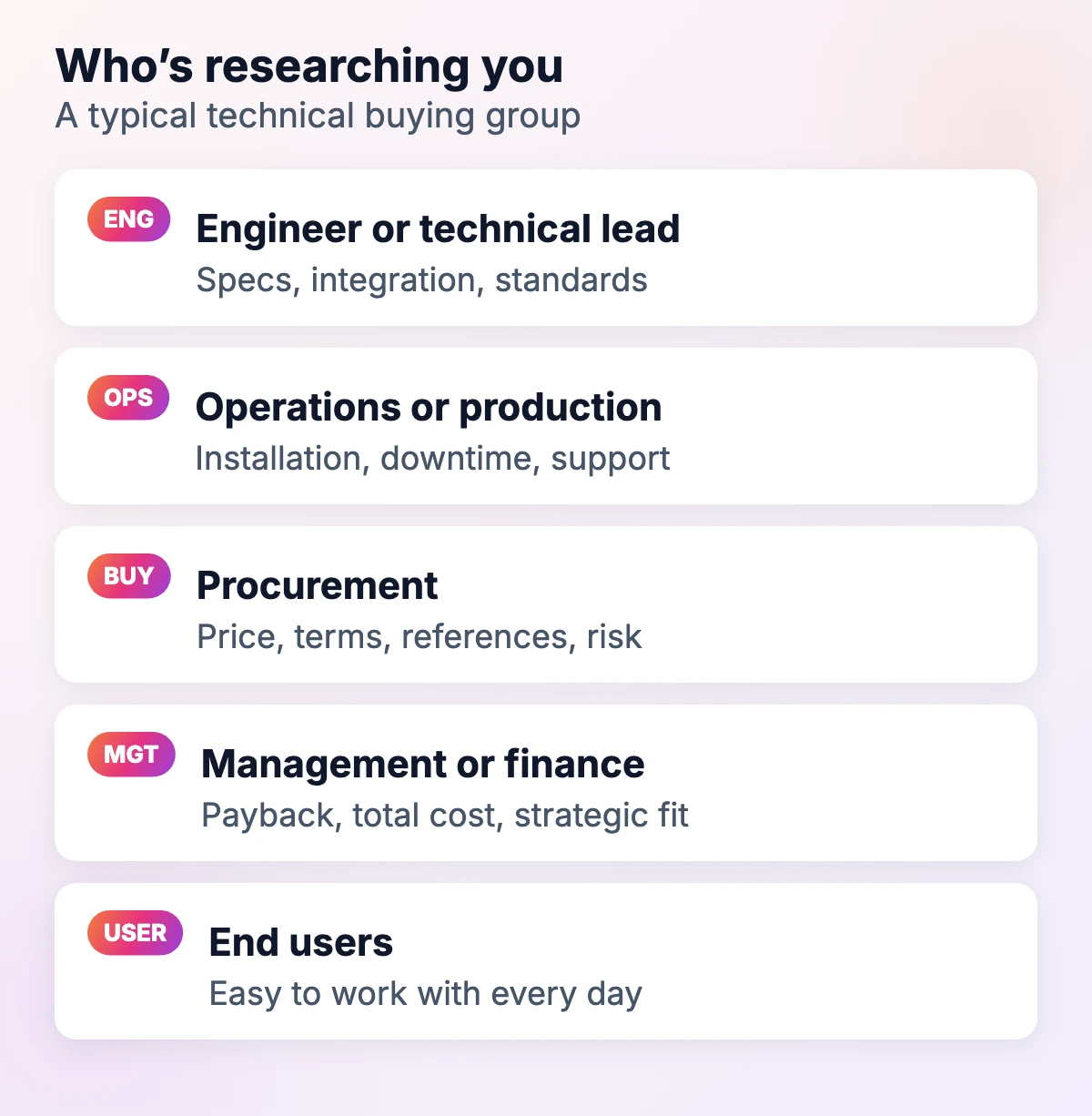
Each of them searches differently, reads different pages and needs different proof. A website that only speaks to one of them, usually the engineer or usually management, leaves the others to look elsewhere.
Where they look
Technical buyers use a mix of sources, and the mix shifts as the project moves forward:
- Google, with very specific searches about problems, applications, specs and standards.
- AI tools like ChatGPT and Perplexity to get a quick overview or a first shortlist. We wrote about how to get recommended by ChatGPT and AI search separately.
- Supplier websites, especially application pages, data sheets, case studies and pricing information.
- Trade media and industry newsletters to see who’s active and credible in the field.
- LinkedIn to check the company and the people behind it, and to see what peers recommend.
- Trade shows to see equipment in action and talk to experts face to face.
- Colleagues and peers who’ve bought something similar before.
You don’t need to be everywhere. But you do need to be findable in the places your buyers actually use, and consistent across them.
What they need to find at each stage
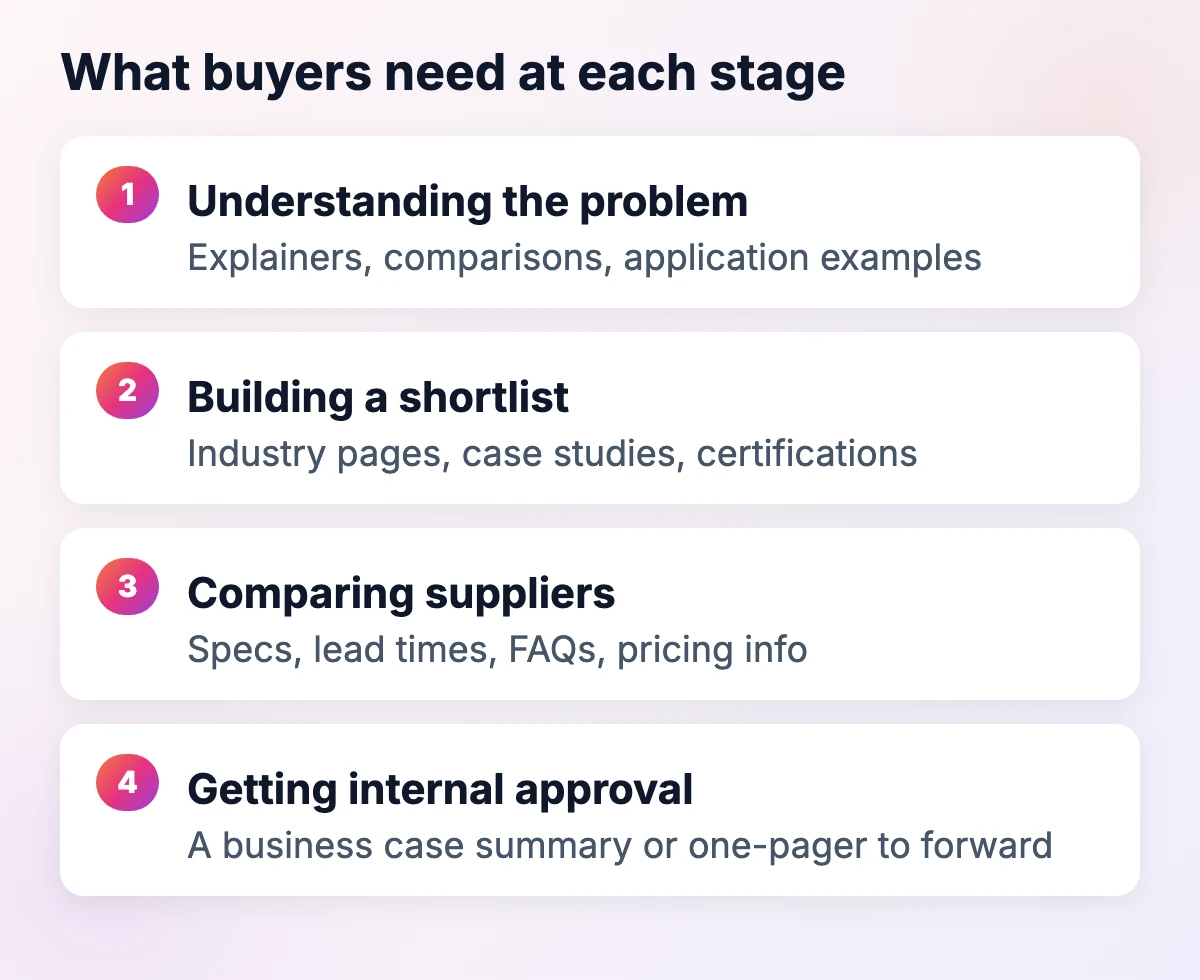
1. Understanding the problem
Early on, buyers are trying to understand their options. They search for problems and comparisons, not brand names. Useful content here: articles that explain approaches and trade-offs, comparison pages and application examples. This is where SEO and expert-led content do most of the work.
2. Building a shortlist
Next, they look for suppliers that can solve their specific problem. They want to see that you’ve done it before, for companies like theirs. Industry pages, case studies with real numbers, certifications and references matter most at this stage.
3. Comparing suppliers
Now the details count: specs, lead times, service, integration, pricing models. If buyers can’t find this information, they often move on to a supplier who makes it easier. Clear data sheets, FAQs and honest information about how you work help a lot.
4. Getting internal approval
Finally, your contact has to convince others internally. Give them something to forward: a short summary of the business case, a relevant case study, or a one-pager that explains your solution for a non-technical reader.
Not sure which of these stages your website covers? We help B2B companies in food tech, SaaS and ICT build content for every person in the buying group. Tell us what you sell.
A quick check for your website
Go through your website as if you were each person in the buying group. Can they find answers to these questions in a few clicks?
- What exactly do you sell, and for which industries and applications?
- Have you solved this problem before, for a company like mine? Where’s the proof?
- What are the specs, standards and certifications, in text rather than only in a PDF?
- How does installation, onboarding and support work?
- Roughly what does it cost, or how is pricing calculated?
- Who will I be talking to, and how quickly will they get back to me?
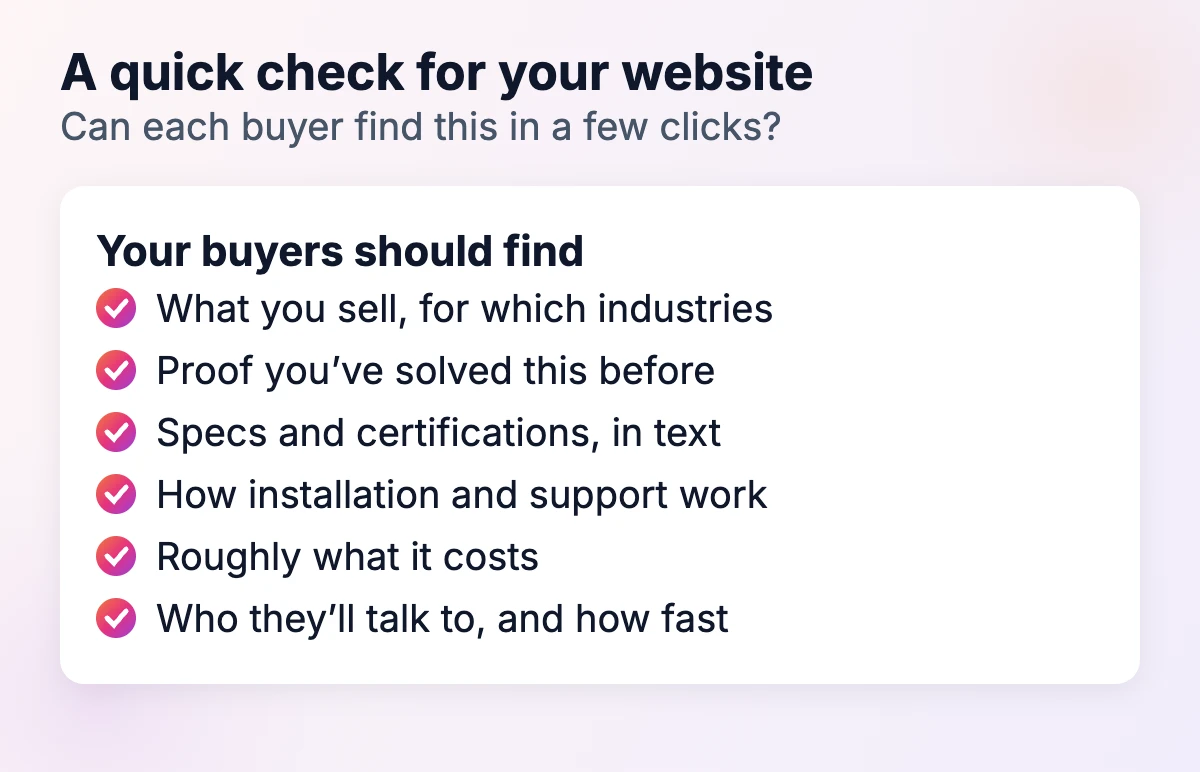
If any of these takes more than a minute to find, you’ve found your first improvement.
Make it visible
Good information only helps if people can find it. A few practical steps:
- Create separate pages for your main applications and industries, so each can rank for its own searches.
- Put specs and key facts in text on the page, not only in downloads.
- Publish case studies with concrete results and the type of customer, even if you can’t name them.
- Share your experts’ knowledge on LinkedIn, where engineers and managers check out suppliers.
- Use trade shows to start conversations, then follow up properly. Our guide on following up trade show leads explains how.
For one B2B food tech company, targeted LinkedIn campaigns aimed at R&D and product development teams led to 74% more qualified website traffic in six months. Read the case study.
Frequently asked questions
It varies, but in technical purchases it’s usually several people from engineering, operations, procurement and management, each with their own questions and priorities.
Late. The 6sense Buyer Experience Report 2025 found buyers first contact sellers about 61% of the way through their journey, often with a shortlist already ranked.
Clear specs and standards in text, application examples, case studies with real numbers, honest information about pricing and support, and something they can forward internally.
Increasingly, yes. In the same 6sense report, 94% of buyers said they use large language models during their buying process, often to build a first overview or shortlist.