
I once watched a company put a lot of money into a beautiful stand. The stand worked: it was busy for three days, the team was exhausted, everyone went home happy. Two weeks later, most of the leads were still sitting untouched in a spreadsheet. Nobody had planned what would happen after the show.
I see some version of this all the time, especially in industries like food tech and ICT and connectivity, where trade shows are still a big part of the sales calendar. And it’s a shame, because following up on trade show leads isn’t complicated. It just needs to be planned before the show, not after it.
The short version: sort your leads while you’re still at the stand, contact the best ones personally within 48 hours, and give everyone else a reason to remember you over the next few months.
Plan the follow-up before you book the stand
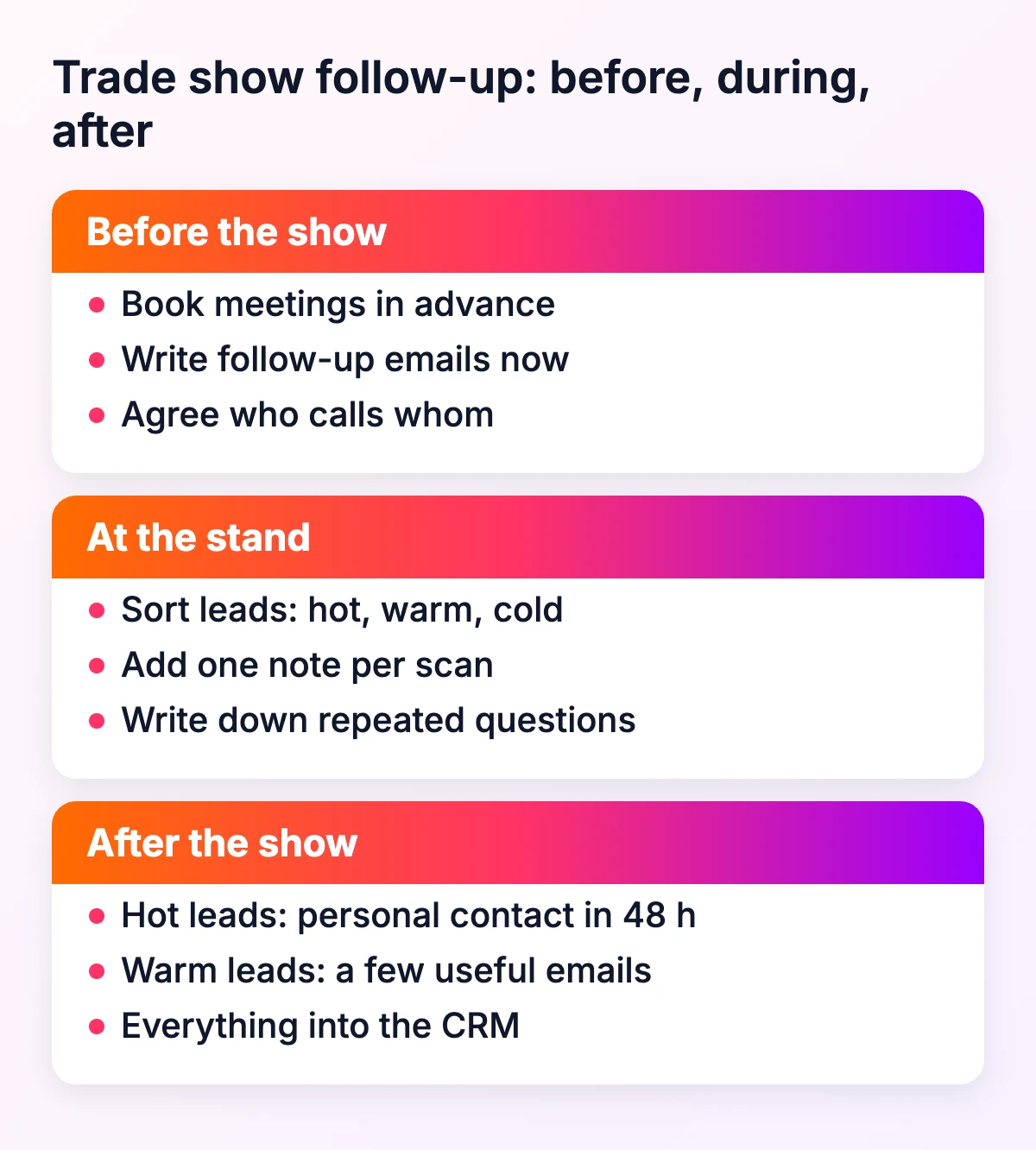
The follow-up starts weeks before the doors open. A few things to sort out while there’s still time:
- Contact the people you’d really like to meet and book time at your stand in advance.
- Agree who follows up on which leads, and when. Put the time in everyone’s calendar for the days after the show (it’s always the first thing to slip).
- Write your follow-up emails now, while you’re not tired. You’ll find templates further down.
- Set up a simple landing page for the show: what you’re exhibiting, a short video, a way to book a call.
Companies often spend a huge amount on the trade show itself and almost nothing on what happens before or afterwards. For me, the show is only one part of the campaign. The interesting bit is how you build interest beforehand and what you do with all those conversations afterwards.
Lot, Lum Collective
At the stand: qualify while you’re talking
Not every badge scan is a lead. Some people wanted a pen, some are competitors, some are students. (You can spend months on your messaging and the biggest crowd will still show up when someone puts free chocolates on the counter.) If you treat everyone the same, your best prospects get the same generic email as everyone else.
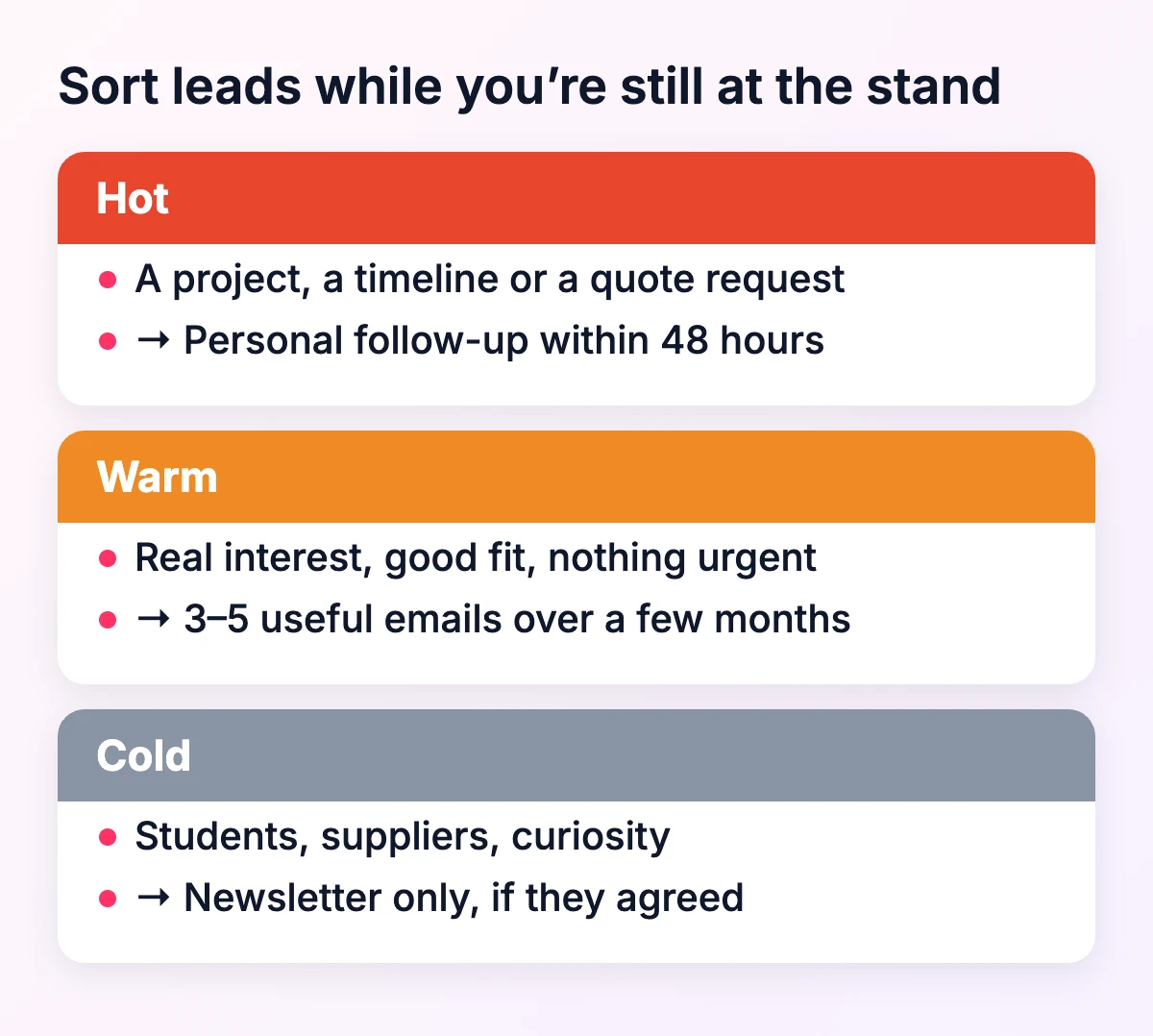
So sort people into three groups while the conversation is still fresh:
- Hot: a concrete project, a timeline, or a request for a quote, sample or visit.
- Warm: real interest and a good fit, but nothing happening right now.
- Cold: general curiosity, students, suppliers, or people outside your market.
And ask your team to add one short note to every scan: the problem they mentioned, the product they looked at, the next step you agreed. “Coverage problem in warehouse, wants demo in Q1” is worth a lot more than a name and an email address. Most lead scanning apps have a notes field. Use it.
One more thing worth writing down: the questions people keep asking. At one show, several visitors kept asking the same technical question. That question later turned into a blog post and a landing page, because it was clearly something the market was looking for.
The first 48 hours: hot leads
Speed matters more than polish here. Research published in Harvard Business Review, The Short Life of Online Sales Leads, found that most companies respond far too slowly to new leads, and that your chances of reaching and qualifying someone drop quickly as time passes. That study looked at online leads, but it’s the same after a show. The longer you wait, the more the conversation fades.
For hot leads, that means a personal email or call from the person they actually spoke to (not a newsletter), a reference to what you talked about, one clear next step, and ideally something useful attached, like a case study from their sector.
Trade show follow-up email templates
Three templates you can adapt. Keep them short, and always change the bits in brackets. A template that obviously is one doesn’t help anybody.
1. Hot lead: the day after the show
Subject: Our chat about [topic] at [show name]
Hi [first name],
Thanks for stopping by our stand yesterday. You mentioned [the problem they described], and I’ve been thinking about it since.
I’ve attached [case study / application note] from a [similar company / sector] that dealt with something very similar. It shows [one concrete result].
Would [day] or [day] work for a 30-minute call with [colleague / engineer] to look at your situation in more detail?
Best,
[Name]
2. Warm lead: within the first week
Subject: [Show name]: the [product / application] we talked about
Hi [first name],
Good to meet you at [show name]. As promised, here’s a short overview of [what you showed them], plus a page with the technical details: [link].
No rush at all. If [their topic] comes back on the table in the next few months, I’m happy to share what we’ve seen work for other [sector] companies.
Best,
[Name]
3. The “we didn’t really get to talk” email
Subject: Sorry we missed each other at [show name]
Hi [first name],
I saw you came by our stand at [show name], but it was busy and I don’t think we had a proper chance to talk. If you were looking at [product / application], here’s a quick summary: [link].
Is it worth a short call? If not, no problem at all.
Best,
[Name]
Warm leads: stay useful for the next few months
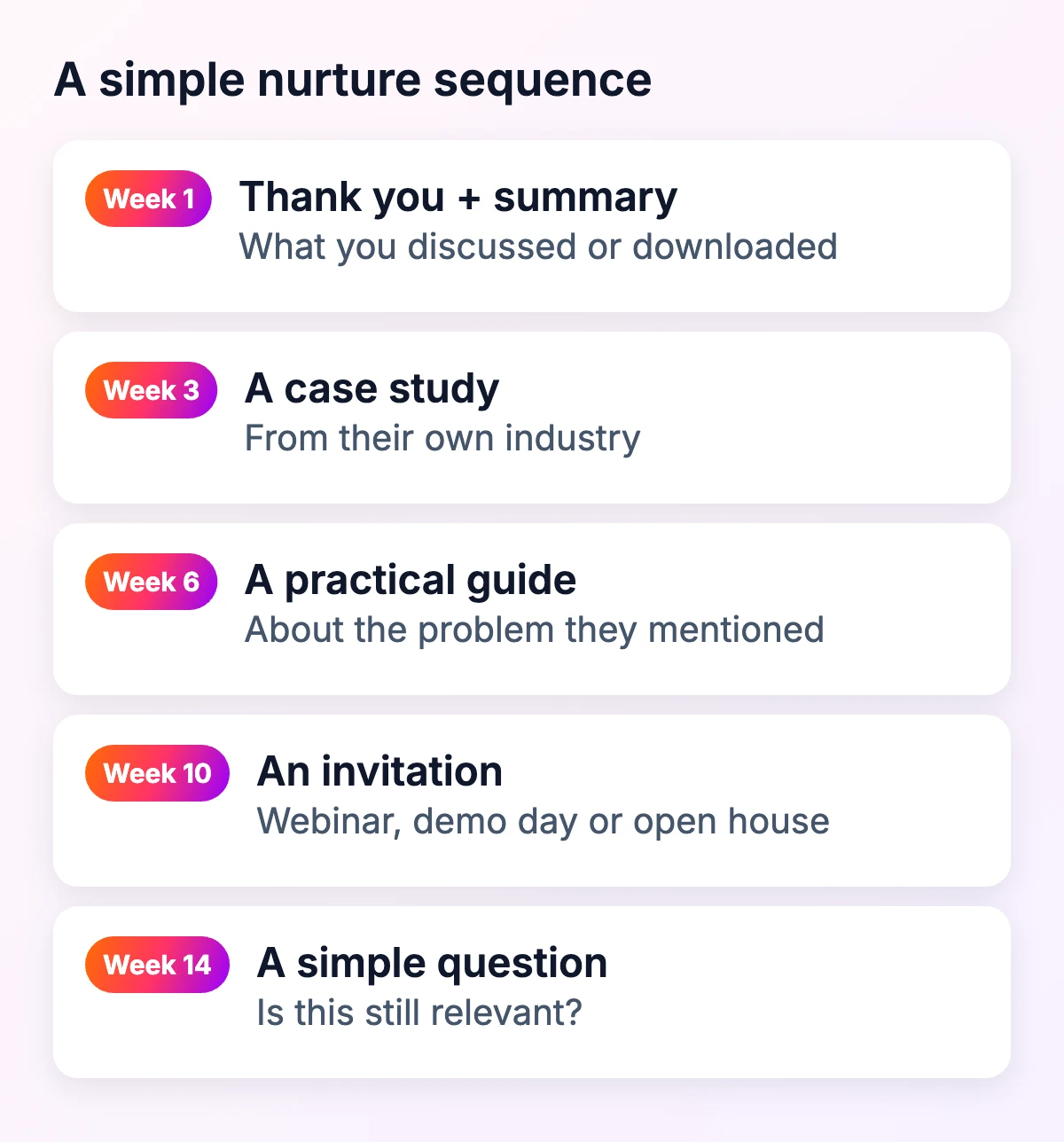
Warm leads aren’t ready to buy, but they might be in six months. Your job is to stay useful until they are. A short sequence of three to five emails over a few months usually works, as long as each one has something worth reading:
- A thank-you with a summary of what you showed at the stand.
- A customer story from their industry.
- A practical guide or checklist related to the problem they mentioned.
- An invitation to a webinar, demo day or open house.
- A simple question: is this still relevant, and should we talk?
Even in a sequence, you can mention the show, their sector and the product they looked at. This is also where good B2B content pays off, because you need case studies and articles to send.
Don’t only follow up on your target list
It’s tempting to focus only on the names you planned to meet. But one of the best trade show conversations I’ve seen happened completely by chance, with someone who wasn’t on any target list. That contact eventually became a much more valuable opportunity than many of the pre-booked meetings. So check the “other” pile properly before you file it away.
Cold leads: add them, don’t chase them
Cold contacts can go into your regular newsletter if they agreed to it. Don’t spend sales time on them. If they get interested later, you’ll notice: they’ll open emails, visit your website or get in touch.
A quick note on privacy: in Europe, GDPR applies to trade show contacts too. Make sure people know what you’ll do with their details when you scan their badge, and only add them to marketing emails if they agreed.
Planning your next trade show? We help B2B companies book meetings before the show and follow up afterwards, so leads turn into sales conversations. Let’s talk about your next event.
Get the leads into your CRM, and look at quality, not volume
Follow-up only works if the leads end up where your sales team works. Import them into your CRM within a day or two, with the hot, warm or cold label and the notes from the stand. Then you can see later which leads turned into meetings, quotes and orders, and whether the show was worth the money.
Be careful with lead counts, though. I’ve seen a company come back from a show thrilled with more than 200 leads. Once the list was cleaned up, only a small share were relevant prospects. Twenty good conversations beat two hundred badge scans.
Two more things help. Use your show landing page in your emails and on printed material at the stand. And run retargeting ads on LinkedIn or Google for people who visited it, so you stay visible while they think it over. That’s part of what we do in B2B paid campaigns. If you want to know which shows actually bring in business, our analytics and reporting work connects trade show leads to your CRM data. And if you want to see how trade shows fit into the rest of your marketing, have a look at our guide to marketing for manufacturing companies.
What it looks like when it works
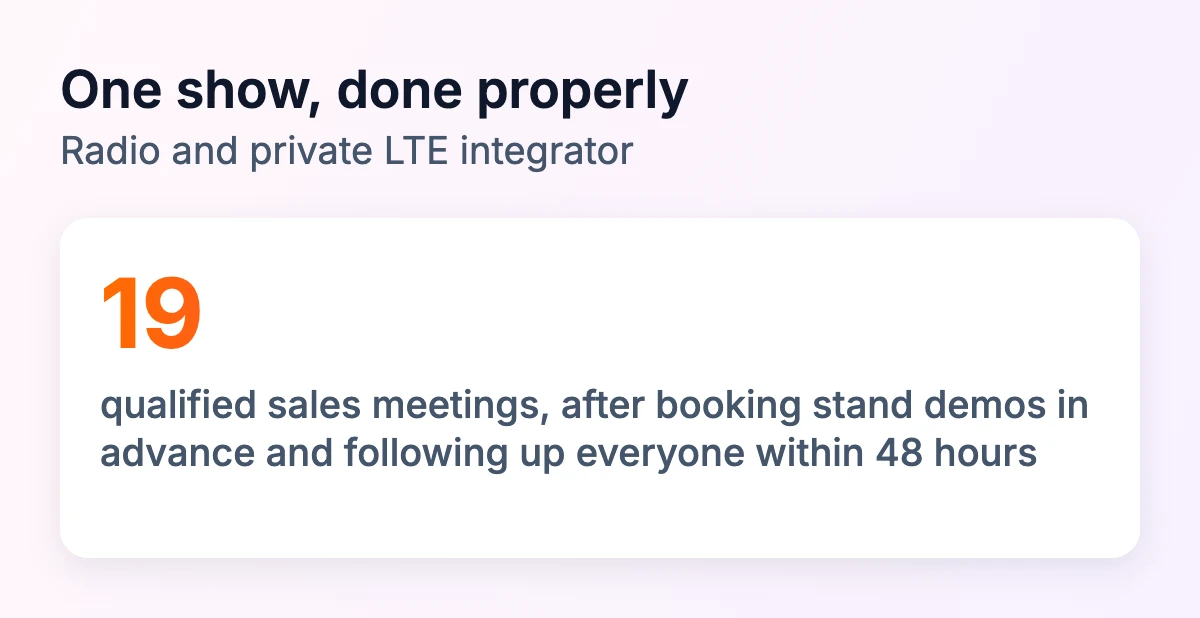
We did exactly this for a radio and private LTE integrator. Before the show, we contacted operations managers at ports and logistics sites to book demos at the stand. Afterwards, everyone got a follow-up within 48 hours with a use case from their own sector. One show led to 19 qualified sales meetings. Read the trade show case study.
Picking the right shows is part of the plan too. Associations like AUMA publish international trade fair calendars, which help you compare events before you commit a budget. And since buyers do most of their research before they talk to anyone, it’s worth reading how engineers and procurement teams research suppliers as well. I’ve also put together a 2027 calendar of food and manufacturing trade shows in Europe.
Frequently asked questions
Plan the follow-up before the show, sort leads into hot, warm and cold at the stand, contact hot leads personally within 48 hours, and keep warm leads interested with a few useful emails over the following months. Then track in your CRM which leads turn into meetings and orders.
Hot leads within 48 hours, ideally the next working day. Warm leads can get a first email in the same week, followed by a short sequence over the next few months.
A reference to what you talked about, one clear next step (a call, a demo, a sample), and something useful like a case study from their sector. Keep it short and personal, and don’t send everyone the same email.
Add every lead to your CRM with its source and label, then track how many turn into meetings, quotes and orders. Compare that with the total cost of the show, including travel and time away from the office.
Not automatically. Under GDPR you need a legal basis. Make it clear at the stand what you’ll do with people’s details, and only add them to marketing emails if they agreed.