

A lot of B2B research now starts with a question typed into an AI tool. “Which suppliers make hygienic conveyors for bakery lines?” “What’s the difference between these two sensor technologies?” “Give me a shortlist of agencies that do B2B SEO in Spain.” The answer comes back as a few paragraphs and a handful of names. If yours isn’t one of them, you’ve lost a buyer before they ever visited your website.
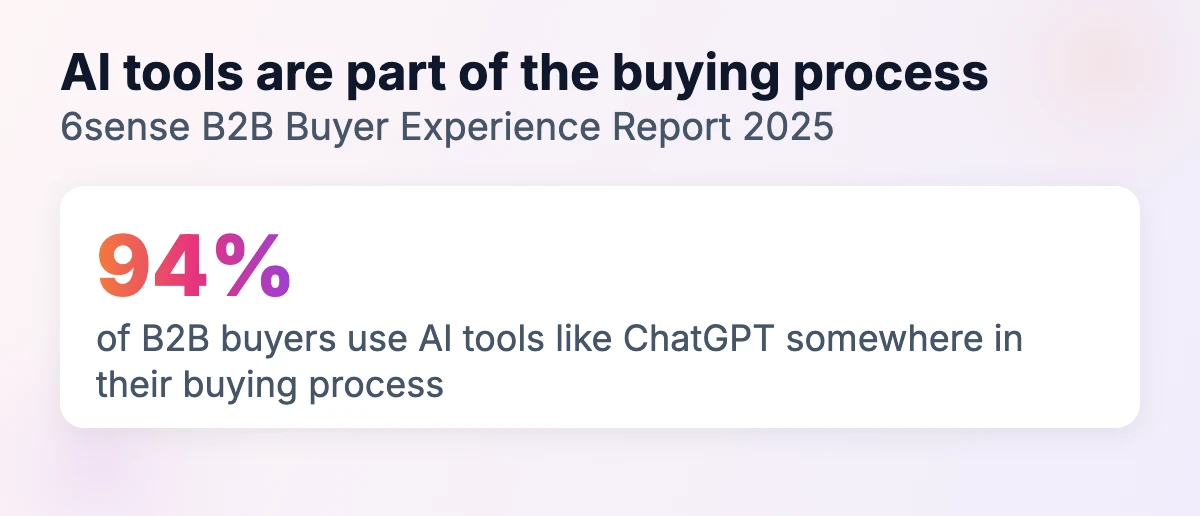
This isn’t a niche habit anymore. In the 6sense B2B Buyer Experience Report 2025, 94% of B2B buyers said they use large language models like ChatGPT somewhere in their buying process. So the question we get from clients has changed from “should we care?” to “how do we show up?”
There’s no secret trick to getting recommended by ChatGPT or Google’s AI answers. What helps is mostly what makes a good B2B website: clear pages that answer real questions, consistent information about your company, and other sites talking about you.
How AI tools pick their sources
Tools like ChatGPT, Perplexity, Gemini and Google’s AI Overviews combine two things: what the model learned during training, and what it finds on the web at the moment you ask. That second part works a lot like a search engine. The tool runs searches, reads the pages it finds and writes an answer based on them, often with links to the sources.
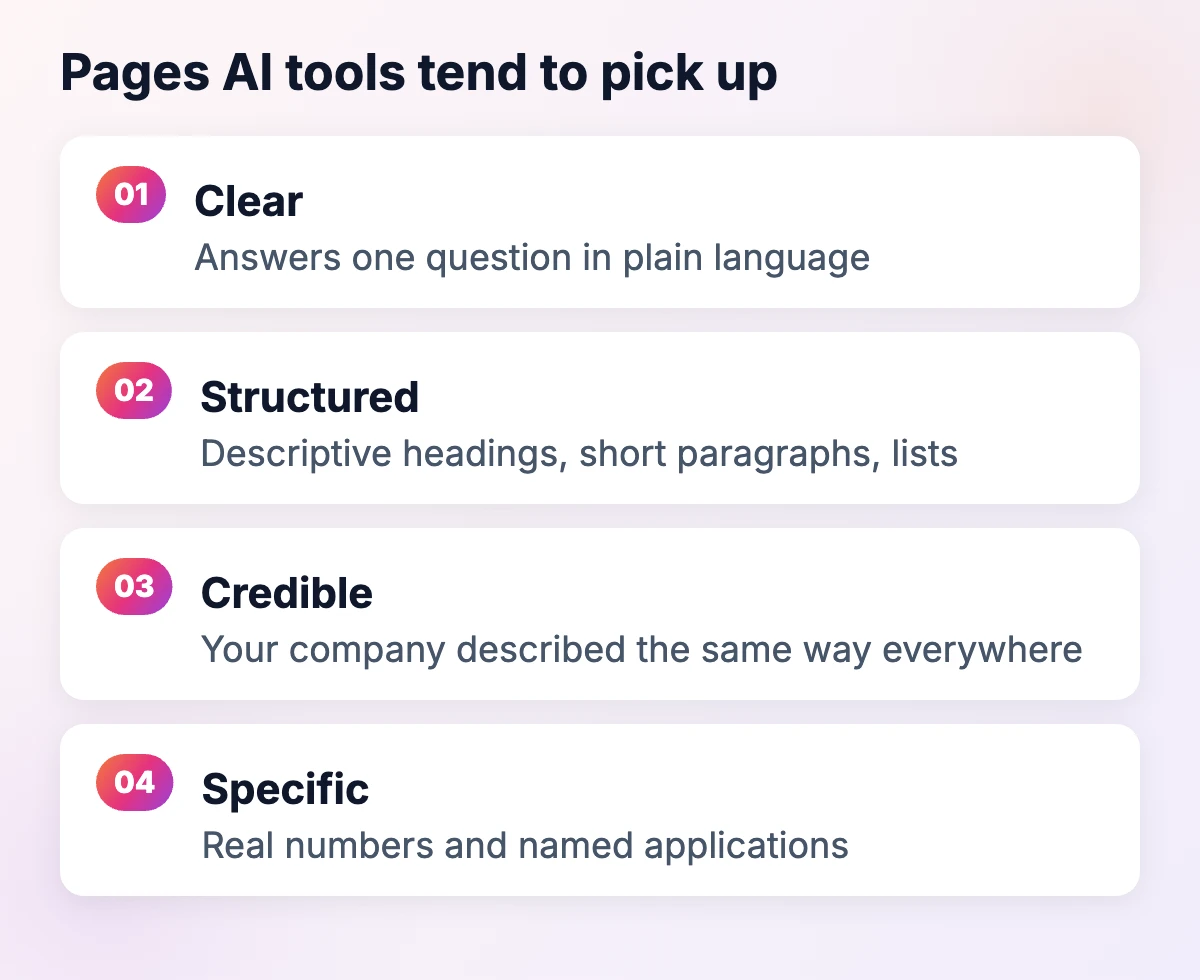
From the work we do in B2B SEO, the pages that get picked up tend to be:
- Clear. The page answers one specific question in plain language, ideally in the first sentence or two.
- Structured. Descriptive headings, short paragraphs and lists make it easy for a tool to pull out the right part.
- Credible. Your company is described the same way on your own site and on other sites.
- Specific. Real numbers, named applications and concrete examples instead of slogans like “innovative solutions”.
Google is clear that there are no special tricks for its own AI features. Its guidance on AI features and your website says a page only needs to be indexed and eligible to show a snippet in normal search. No extra files, no special markup.
Answer the questions buyers actually ask
AI tools are answering questions, so the easiest way to be part of the answer is to have a page that answers the same question well. Start with the answer, then explain. If someone asks “what’s the difference between X and Y?”, your page should say what the difference is in the first paragraph, not after three paragraphs about your company history.
Good places to find those questions:
- Your sales team. Ask what prospects ask on the first call, and what they get wrong.
- Your support inbox and the questions customers send after they’ve bought.
- Trade show conversations. Write down the questions people ask at the stand.
- The “People also ask” boxes in Google for your main topics.
FAQ sections help too, for Google as well as for AI tools, as long as the questions are real and each answer makes sense on its own. We write a lot of this kind of B2B content from short interviews with a client’s engineers or product people. They know the answers; they just don’t have time to write them down.
Say clearly who you are and what you do
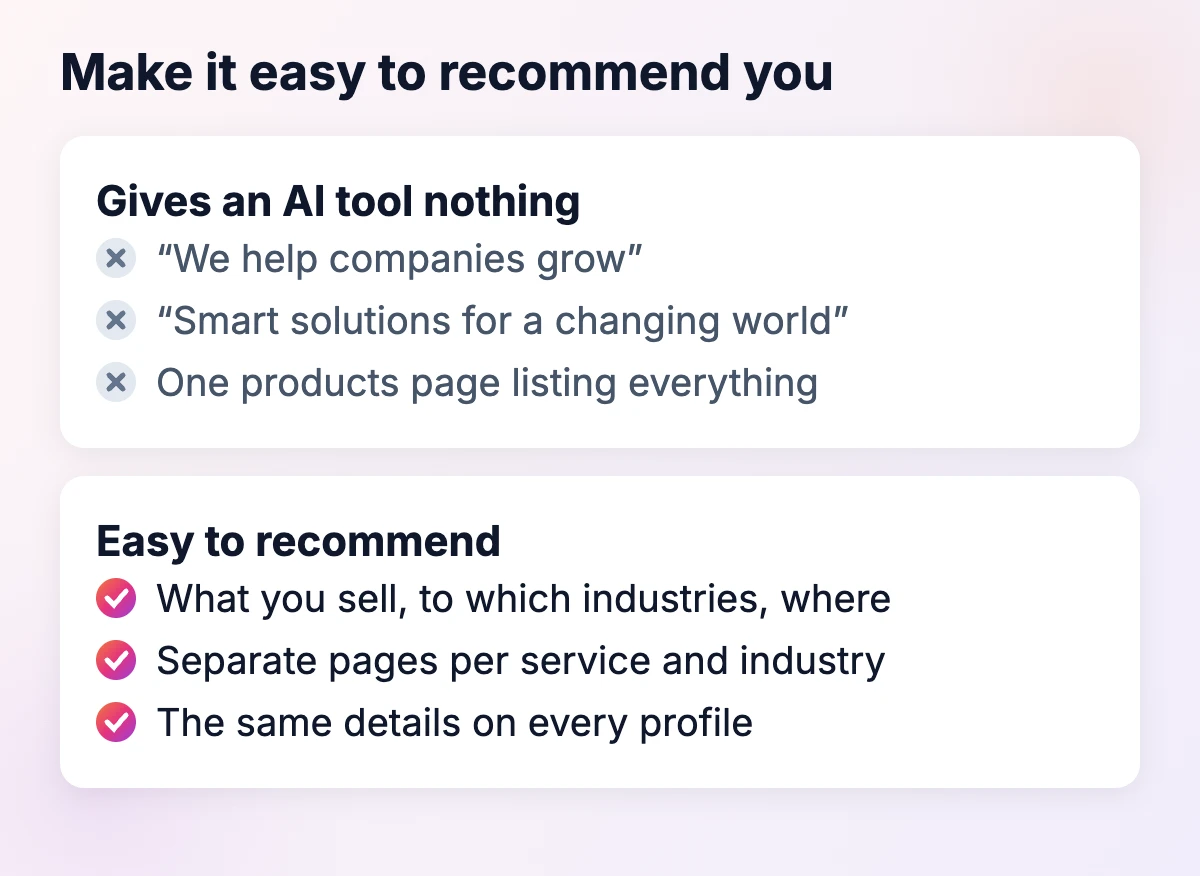
An AI tool can only recommend you for something if it understands what you do, for whom and where. Many B2B websites make that surprisingly hard. “We help companies grow” or “smart solutions for a changing world” gives a tool nothing to work with.
Make it explicit:
- A clear one-line description on your homepage and About page: what you sell, to which industries, in which countries.
- Separate service and industry pages that name the sectors, applications and problems you work on.
- The same company details everywhere: your website, LinkedIn page, Google Business Profile and industry directories.
- Structured data, such as Organization markup, that tells search engines your official name, logo and contact details.
This is also why we’d always rather have ten focused pages than one page that lists everything. A page about “hygienic conveyor belts for bakeries” has a much better chance of being used as a source than a generic “products” overview.
Want to know how your company shows up in AI answers today? AI visibility is part of every SEO project we run. Ask us for a quick check.
Get mentioned on other sites
AI answers lean heavily on what other people say about you. If the only place your company is described is your own website, you’re easy to overlook. Mentions in trade media, industry directories, partner websites and review platforms all add up.
The good news is that this is the same work that builds trust with human buyers: expert articles, customer stories and being visible where your buyers already read. For one food processing technology client, online PR led to 31 articles and mentions in trade media and 52% more people searching for the company by name. You can read that case study here.
Don’t block the tools you want to be found by
This one sounds obvious, but we see it more often than you’d think. Some websites, CDNs and security plugins block crawlers by default. If the crawler of an AI search tool can’t read your pages, it can’t use them as a source. Check your robots.txt file and your hosting or firewall settings, or ask your developer to do it. Google’s guidance also mentions keeping important content in text rather than in images, and linking to your key pages from elsewhere on your site.
Check whether you appear
The simplest test is to ask the tools yourself. Write down ten to twenty questions your buyers would realistically ask, in every language you sell in, and try them in ChatGPT, Perplexity and Google. For each one, note:
- Whether your company is mentioned at all.
- Which competitors are mentioned instead.
- Which sources the tool cites, and whether you could get onto those sites.
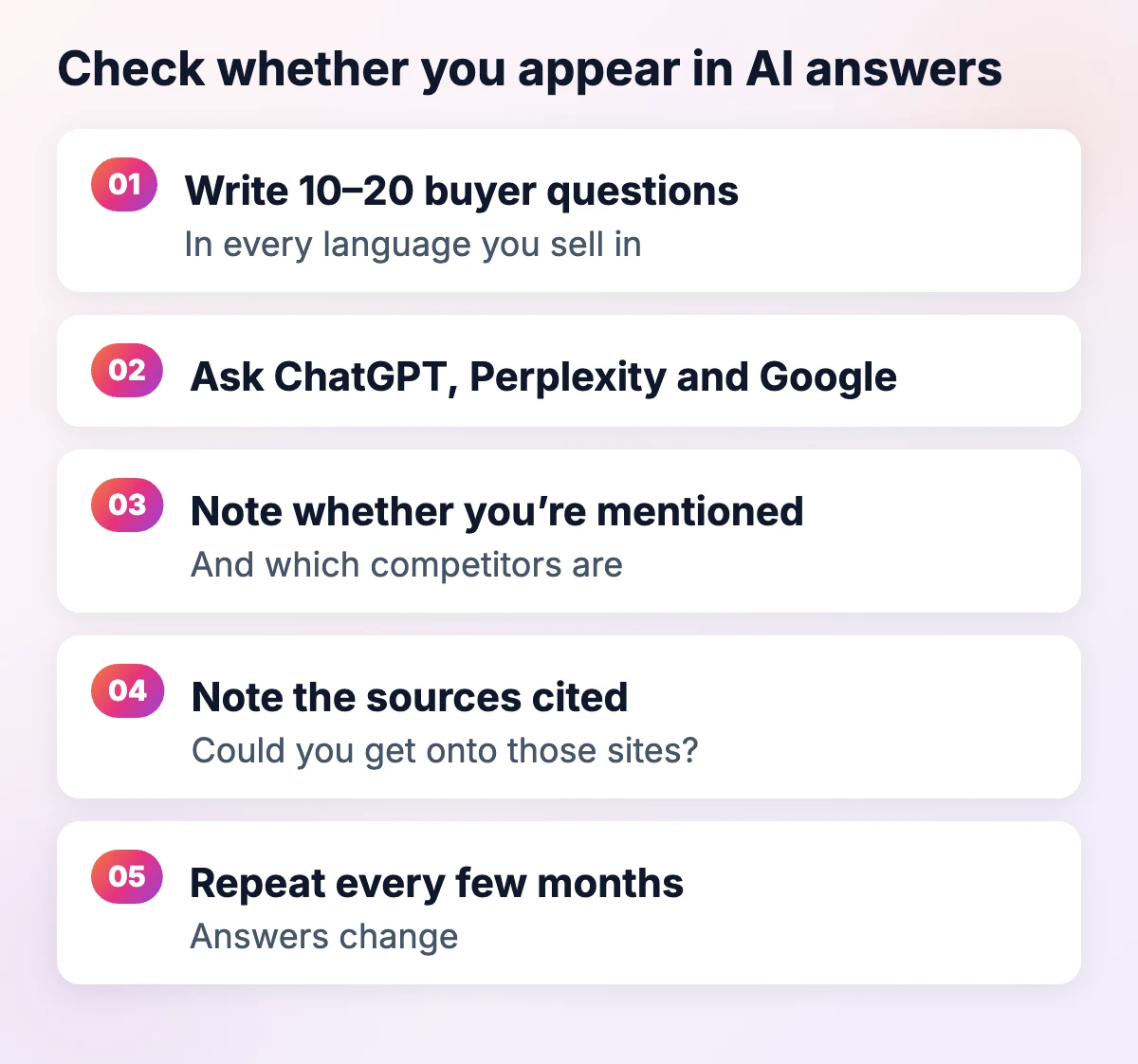
Repeat it every few months. Answers change, and it’s the most direct way to see whether your work is having an effect. In Google Search Console, traffic from AI Overviews is counted in the normal Performance report, so keep an eye on clicks and impressions for the pages you’ve improved. If you want help setting up that kind of reporting, that’s what our analytics work is for.
What not to bother with
Skip anything that promises to “trick” AI tools: hidden text, pages stuffed with keywords, or hundreds of mass-produced articles. It doesn’t help with AI answers and it can hurt you in Google, which rewards helpful, people-first content. You also don’t need a special “AI file” on your website for Google’s AI features.
Focus on fewer, better pages that answer your buyers’ questions properly. If you sell technical products, our article on how engineers and procurement teams research suppliers shows which questions each person in the buying group tends to ask. And if you’re a food equipment supplier, read SEO for food processing and packaging equipment suppliers.
Frequently asked questions
No. AI tools build their answers from what they learned in training and what they find on the web. The way in is the same as for good SEO: clear, useful pages and a solid reputation on other sites.
Not for Google. Google says there are no extra requirements to appear in AI Overviews or AI Mode beyond being indexed and eligible for a snippet. Structured data such as Organization markup still helps search engines understand who you are.
It depends on how much content and reputation you already have. In our experience the first changes show within a few months of publishing clear, focused pages, similar to SEO.
Yes, often better than for big brands. Niche questions have fewer good answers, so a specific, well-written page has a real chance of being used as a source.