
B2B MANUFACTURING MARKETING
Marketing for manufacturing companies: a practical B2B guide.
Most manufacturers I talk to know their products better than anyone. Getting the right buyer to find them, understand them and actually trust them? That’s the harder part, and it usually happens months before anyone fills in a contact form. This is how we tackle it at Lum Collective.
By Lot, Lum Collective · Updated October 2026 · 12 min read
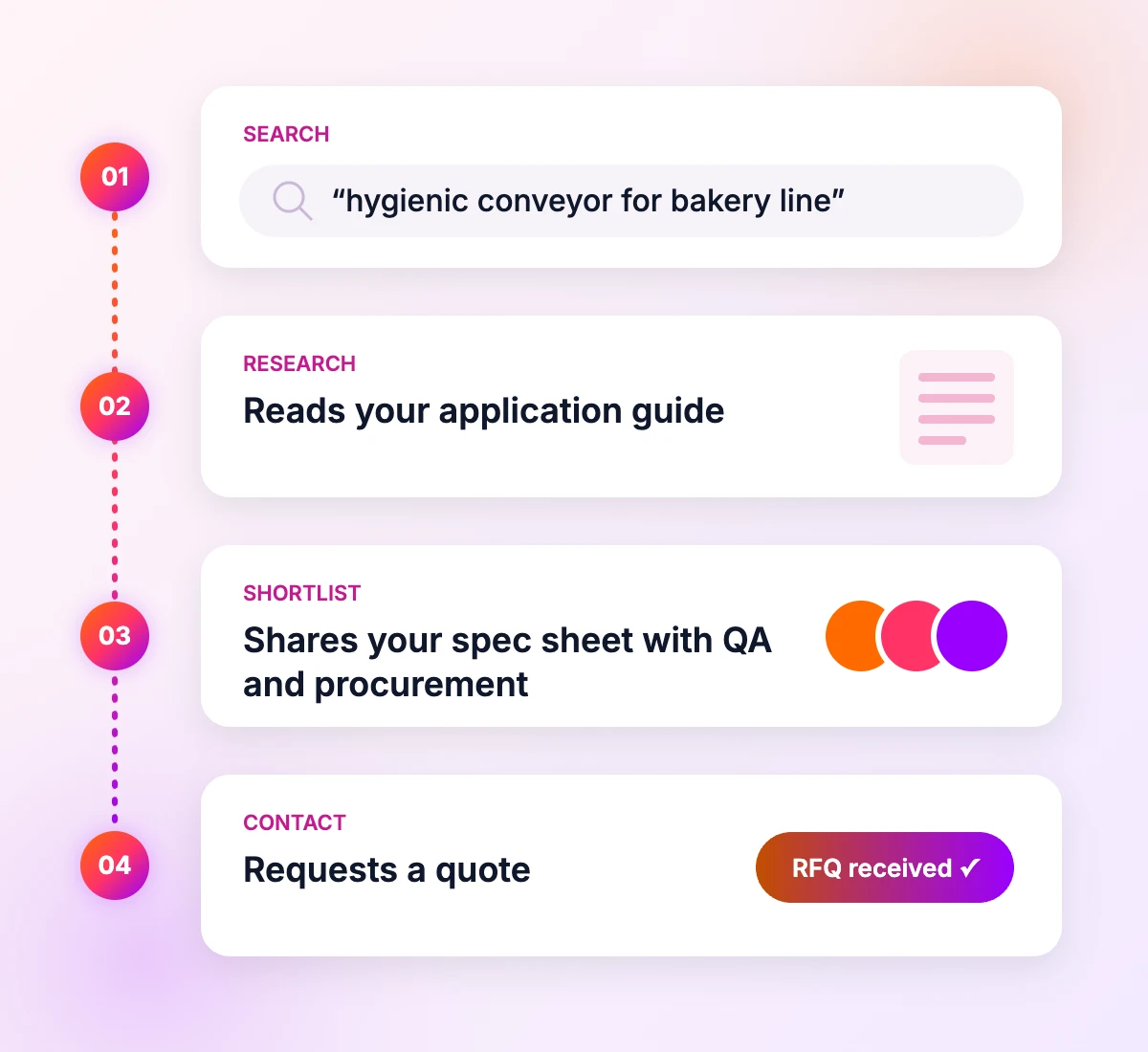
The short version: your buyers are comparing you online long before they call. By the time they do, they should already get what problem you solve, and why you’re the safer bet.
Most of the manufacturers we work with grew through sales reps, distributors and trade shows. Those still matter. What’s shifted is when buyers get in touch. According to the 6sense B2B Buyer Experience Report 2025, buyers first reach out about 61% of the way through their journey, and by then they usually have a ranked shortlist. Gartner’s research points the same way: most B2B buyers would rather not deal with a sales rep at all if they can avoid it.
So if you’re hard to find, or hard to understand once someone does find you, you’re probably not on that shortlist. The upside? Manufacturing is still a pretty quiet corner of the internet. You don’t need to shout louder than anyone. You need to show up and make sense.
In this guide
- What makes marketing in manufacturing different
- Positioning, ideal customers and the buying committee
- Building a manufacturing marketing plan
- The marketing channels that work for manufacturers
- Turning marketing into pipeline
- Launching new products and entering new markets
- Marketing for food and ingredient manufacturers
- Measuring pipeline, not page views
- Marketing ideas you can start this quarter
- FAQ
What makes marketing in manufacturing different
Selling a machine, an ingredient or a component isn’t like selling software, and it’s definitely not like selling shampoo. A few things change almost everything.
There’s never just one buyer. You’ll usually have engineering, procurement, quality, operations and finance around the table, all with different questions, and any one of them can stop the deal. It also takes a while: six to eighteen months is pretty normal for equipment or a new ingredient, with samples, trials or acceptance tests somewhere in the middle.
People rarely search for you by name. They search for an application, a tolerance, a standard. And in food, compliance is part of what you’re selling: hygienic design (think EHEDG guidelines), certifications, traceability. Saying you’re compliant isn’t enough; buyers want to see the documents.
Then there’s the size of the market. Some manufacturers only need a handful of new customers a year, sometimes through distributors or agents. This is where a lot of standard B2B marketing advice doesn’t really fit. If your whole market is a few thousand plants, chasing traffic or followers won’t get you very far. Being the supplier who explains things best when those few people go looking will.
Start with the foundation: positioning, ideal customers and the buying committee
Before you think about channels, I’d get three things clear.
First: who are your best customers, by application? Company size matters less than what they do with your product. A food equipment maker selling into dairy, bakery and ready meals really has three different stories to tell (different regulations, different problems, different search terms).
Second: why should anyone pick you? In industrial markets the answer needs to be concrete. Uptime, cleaning time, yield, energy use, compliance, how fast your service engineer shows up. If you can put a number on it, put it up front.
“The most common mistake I see is talking too much about the product and not enough about the problem it solves. Manufacturers know their products inside out, so the website gets very technical very quickly. But the buyer still needs to know: is this relevant to me, why is it better, and why should I trust you? A lot of my job is translating that knowledge into something people can find and understand, without dumbing it down.”
Lot, Lum Collective
Third: who’s actually involved in the decision, and what does each of them need from you? (I go through this whole process step by step in industrial marketing strategy in 8 steps.) It usually looks something like this:
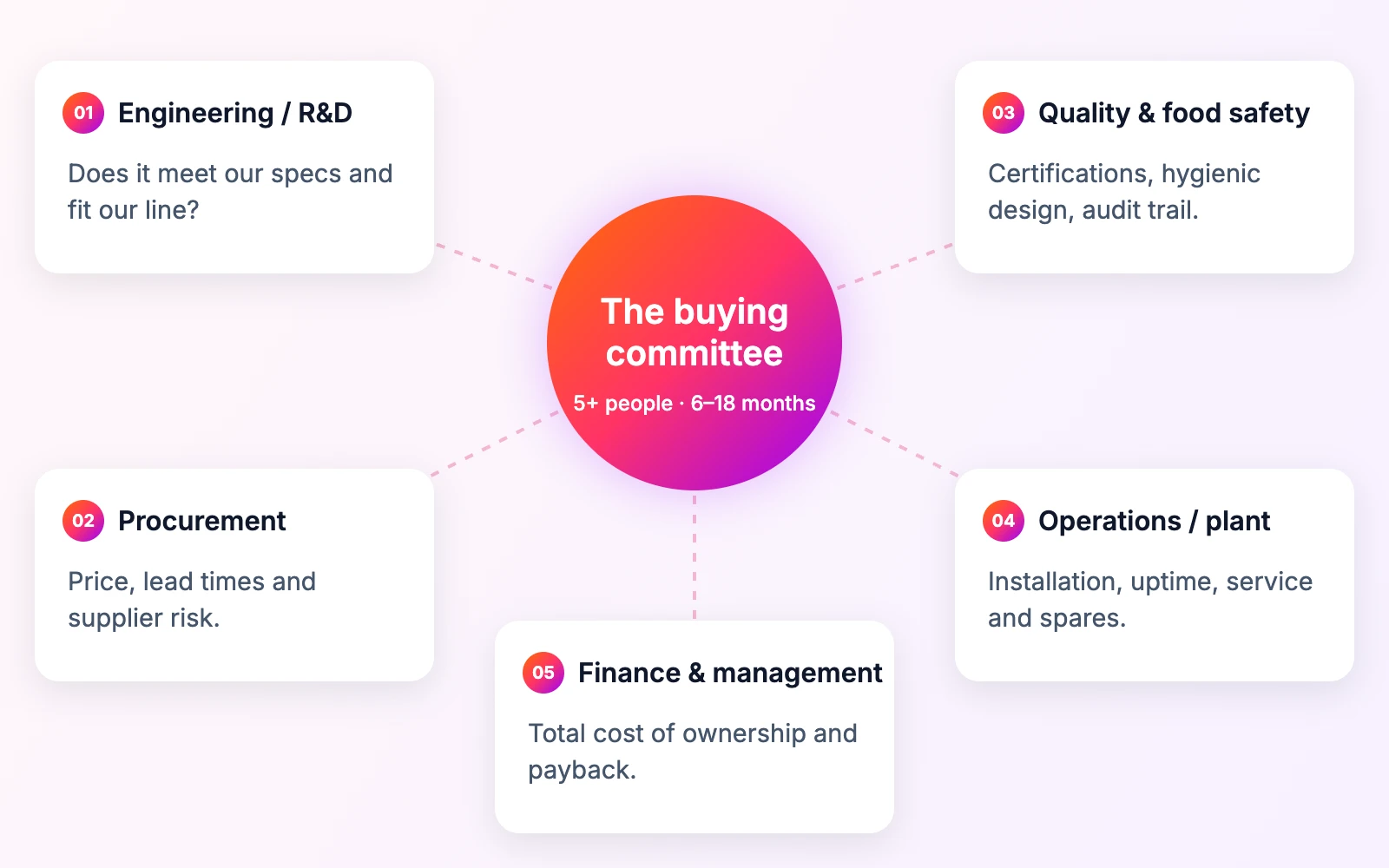
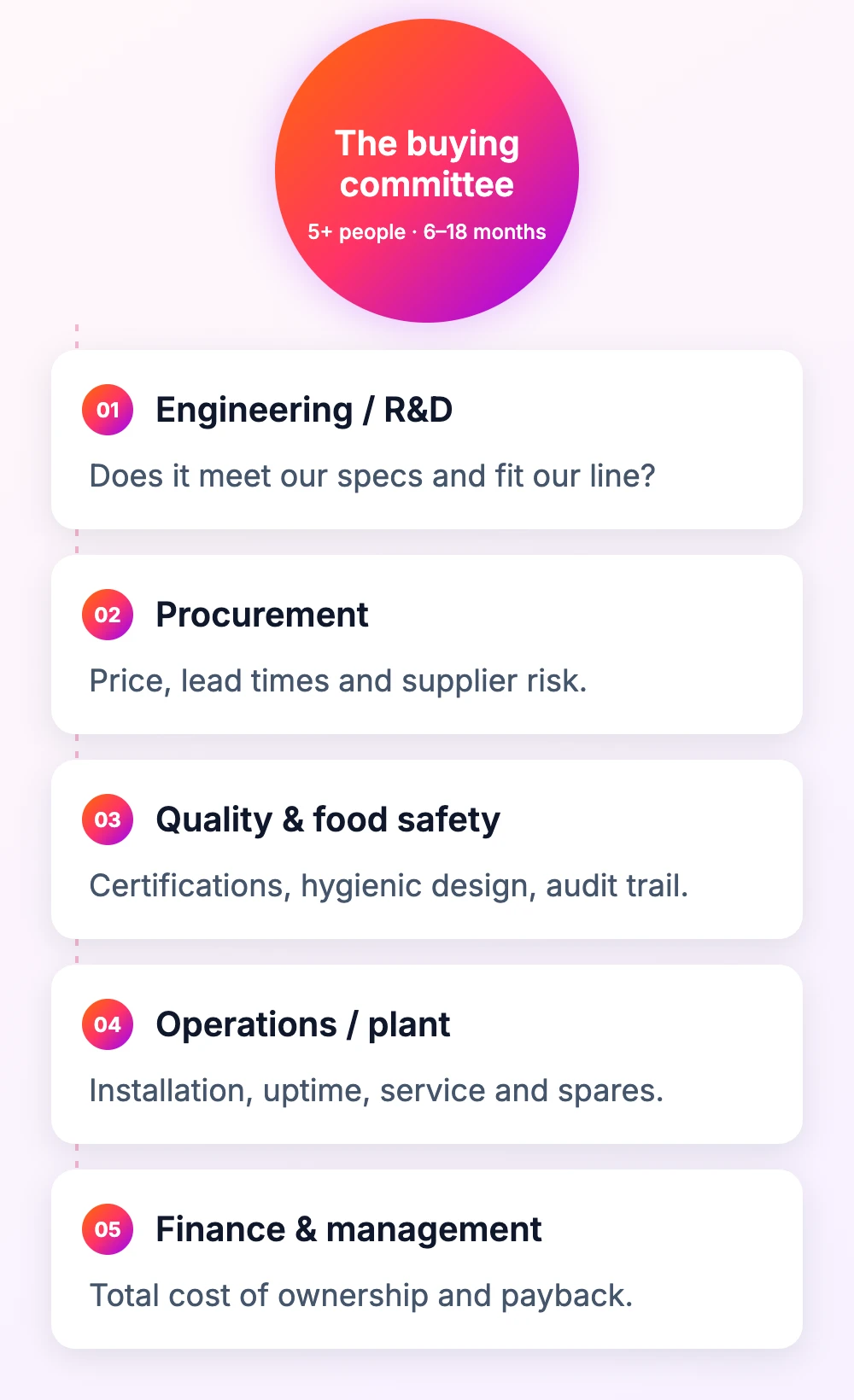
Most manufacturer websites I see are written for the engineer, often in a PDF. Procurement, quality and finance get very little. Give them something to work with and you’re already ahead of a lot of competitors. There’s more on this in How engineers and procurement teams research suppliers online.
Build a manufacturing marketing plan
Your plan doesn’t need to be a 40-page document. A few pages is plenty, as long as it answers:
- how many qualified opportunities you need each quarter (and from where)
- which applications, markets and buyers you’re going after
- what you want to be known for, and how you’ll prove it
- which three or four channels you’ll focus on this year, and what you’ll stop doing
- what content those channels need
- who does what, in-house or with outside help
- which pipeline numbers you’ll review with sales every month
If sales and management won’t read it, it’s too long. Look at it again every quarter, because things will change. They always do. There’s a one-page marketing plan template in our blog if you want a starting point.
The marketing channels that work for manufacturers
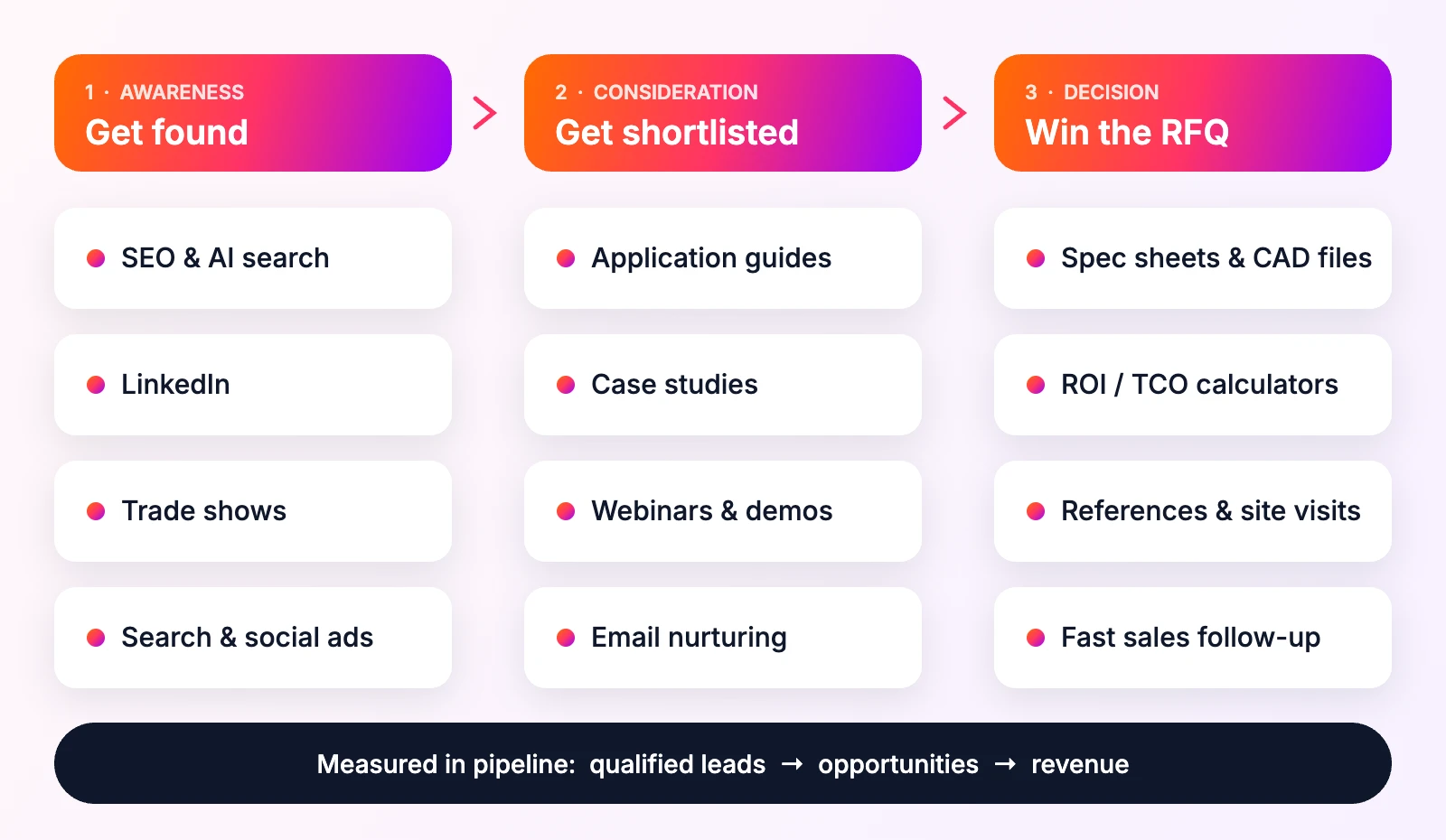
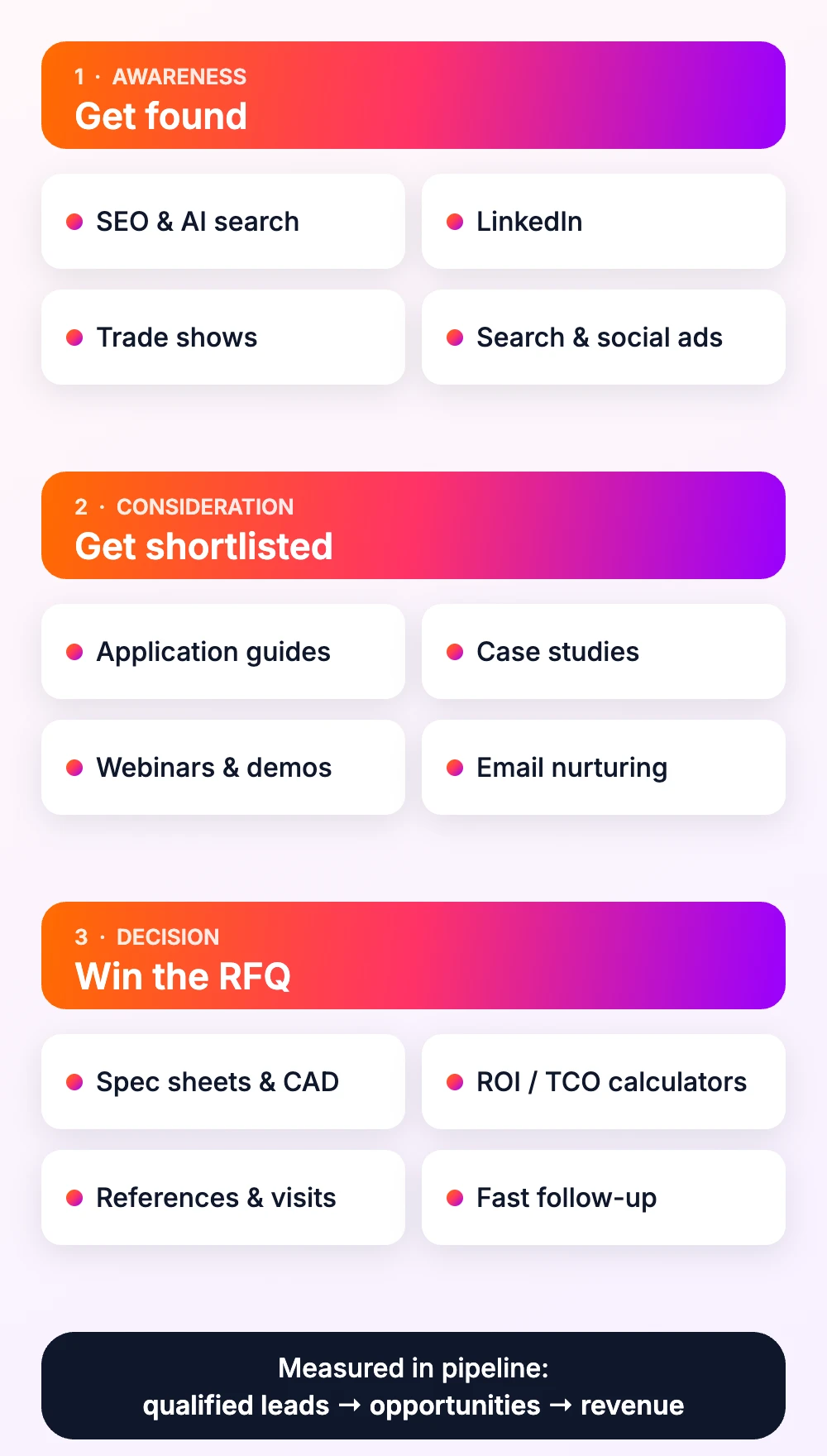
You don’t need to be everywhere. Most manufacturers do best with three or four channels, chosen based on where their buyers already spend time and how long it takes them to decide. This is roughly how they fit together:
Your website
For most industrial buyers your website is the first proper look at your company, and they’re usually trying to answer three questions. What do you make, and for which applications? Will it work for us? And what do I do next? So: a page per application or industry, spec sheets and CAD files people can just download, case studies with actual numbers in them, and a clear way to ask for a quote, a sample or a chat with an engineer.
“In most cases: don’t gate your spec sheets. If I’m already seriously considering your product, making me hand over my details just to see basic technical information is unnecessary friction. Pricing is more nuanced, because it can depend on volumes, configuration or the application, but even then I’d rather give people some indication than just say “contact us”. Gate content when there’s a real value exchange, not just because you want an email address.”
Lot, Lum Collective
SEO and AI search
Engineers search for very specific things: “hygienic conveyor for bakery”, “high-pressure processing equipment supplier”, “clean-label texturiser”. Not many people search for those, but the ones who do are often close to buying, and a good page on a topic like that can keep bringing in the right visitors for years. More and more buyers also ask ChatGPT or Google’s AI Overviews for a shortlist now, and those tools pull from the same kind of clear, specific content. I’ve written more about both in SEO for food processing and packaging equipment suppliers and How to get your B2B company recommended by ChatGPT and AI search, and you can see how we work on our B2B SEO page. The full walkthrough is in SEO for manufacturers.
Content marketing
The best manufacturing content comes from your own people: engineers, application specialists, the service team. They know the answers; they just don’t have time to write them down. We usually start with a 30-minute interview and turn it into an application guide, a case study or a comparison page, then reuse bits of it on LinkedIn, in emails and in a one-pager for sales. And short videos of a machine actually running? Underrated. More on our approach to B2B content marketing. The whole process is in content marketing for manufacturers.
LinkedIn and social media
LinkedIn is where your buyers (and their colleagues) quietly keep an eye on suppliers. It works best with real people behind it: founders, engineers, salespeople posting about what they see in factories. Ads can then target specific job titles, industries or even lists of companies, which is handy when your audience is small. For one B2B food tech company, LinkedIn campaigns aimed at R&D and product development teams brought in 74% more qualified website traffic in six months. More in LinkedIn marketing for manufacturers, or see our LinkedIn and social media service.
Trade shows and follow-up
Trade shows are still one of the best ways to meet buyers in person. (And yes, the machine on your stand will run perfectly for three days and then stop the exact moment your most important prospect walks up.) The bigger problem is usually what happens afterwards. I see it a lot: a great stand, hundreds of conversations, a pile of leads… and then a generic email two weeks later.
So plan the follow-up before the show, not after. Decide who calls whom, write down what each person actually asked about, and get back to them within a few days with something that refers to your conversation. Not a generic “great to meet you” email. Our guide to following up on trade show leads goes into more detail, and our 2027 trade show calendar has the dates.
Advertising for manufacturers
Paid search works well for very specific searches: product types, applications, spare parts. LinkedIn ads let you reach a defined group of people, and retargeting keeps you visible while a deal drags on for months. Start small, and look at cost per qualified lead rather than cost per click. A cheap click from the wrong person is still the wrong person. More on our paid ads service.
Email and account-based marketing
If deals take a year, you need to stay on people’s radar without becoming annoying. A short email every month or two usually does it: a new application note, a case study, which shows you’ll be at. For a handful of really important target accounts, account-based marketing can be worth it. That’s where ads, content and sales outreach all aim at one named list of companies. How this fits into a bigger inbound system is in inbound marketing for manufacturers.
Not sure which channels fit your sales cycle?
Tell us how you sell today and we’ll tell you what we’d change. It’s a 30-minute call.
Turn marketing into pipeline: lead generation and sales alignment
In my experience, this is where things go wrong most often: the handover between marketing and sales. Four things fix most of it. (There’s a lot more on this in lead generation for manufacturers.)
01
Agree what a good lead looks like
Sit down with sales and agree which signals actually matter: application fit, company size, region, timing. A sample request from a target account is worth more than ten newsletter sign-ups.
Don’t get too excited about volume, either. I’ve seen a company come back from a trade show thrilled with more than 200 leads. Once the list was cleaned up, only a small share were relevant prospects.
02
Score and route leads automatically
Let your CRM score leads on fit and behaviour and send them to the right salesperson or distributor straight away. Not to a shared inbox where they sit for a week.
03
Follow up fast
Speed really does matter. Research published in Harvard Business Review found that companies who contacted online leads within an hour were far more likely to qualify them than those who waited. Aim for the same day.
04
Close the loop
Once a month, check which leads turned into opportunities and orders, and use that to adjust what you’re doing. It sounds obvious, but it’s surprising how often this step gets skipped.
Launching new products and entering new markets
A product launch in manufacturing is rarely one big moment. It usually starts with existing customers and distributors, then trials, then a few pilot installations, and the proof builds up as you go. So plan for that: brief your sales team and partners first, get an application page and a data sheet online before the trade show, and turn the first successful installations into case studies as soon as the customer says yes.
New export markets work in a similar way. Find out what buyers there search for and which standards they expect. Adapt your key pages rather than translating them word for word, because the search terms are often different. And build credibility locally through references, shows and partners. We work in English and Spanish, and we write a separate version for each market. Going abroad? Start with our export content marketing checklist.
Marketing for food and ingredient manufacturers
“I like industries where there’s something real to understand. Food tech can be very technical, but behind the technology there’s usually a very tangible problem: producing more efficiently, improving quality, reducing waste, extending shelf life or creating a better product. I enjoy getting into the technical side with the experts and turning that into marketing that makes sense to the person buying it. And because the products are complex, good marketing can make a noticeable difference.”
Lot, Lum Collective
Food adds a few extra layers. Buyers want proof of food safety and hygienic design. R&D and application teams get involved, especially with new ingredients. And a lot of suppliers sell to brand owners, who care about labels, claims and consumer trends at least as much as specs.
What tends to work: an application page for each category you serve (bakery, dairy, meat, plant-based, beverages). Technical proof people can actually find, like certifications, cleaning validation or shelf-life data. A name and a story for your key ingredient, so brand owners can use it on their packaging. LinkedIn campaigns aimed at R&D, quality and product development. And a trade show calendar built around the big food and processing fairs, with the follow-up planned in.
This is the part of manufacturing we know best. Read more about our marketing for food tech companies, or have a look at some results below.
Results for food manufacturers we work with.
31
Articles and trade media mentions for a food processing technology company
+74%
Qualified website traffic for a B2B food tech company after targeted LinkedIn campaigns
Measure pipeline, not page views
Traffic, likes and impressions look nice in a report, but they don’t tell you much. For a manufacturer, the numbers that matter are the ones your sales team and management already care about: qualified leads (by channel and segment), opportunities and what they’re worth, win rate, deal size, how long it takes to go from first contact to order, and what each qualified lead costs you.
To see that, your website analytics, forms and CRM need to talk to each other. It takes a bit of setup. But once it’s there, you can finally see which campaigns lead to actual deals and move your budget accordingly. Our analytics and reporting service sets this up for B2B teams.
Marketing ideas you can start this quarter
Want to get started while the bigger plan is still taking shape? These are all things you could do this quarter:
- Ask sales for the ten questions they hear most often, and answer them on your website.
- Take your best customer story and turn it into a case study with real numbers (output, downtime, yield, cost).
- Remove the forms from your spec sheets. Ask for details when someone wants a quote or a sample instead.
- Write one page for each key application or industry.
- Plan the follow-up for your next trade show now. And while you’re on the stand, write down the questions visitors keep asking: they’re often your next blog post.
- Get one engineer to post on LinkedIn once a month about a problem they solved.
- Ask ChatGPT what it knows about your company. You might be surprised. Then fix the gaps on your own website.
Questions about manufacturing marketing.
How do manufacturing companies market themselves?
Usually through a mix of their website, technical content, SEO, LinkedIn, trade shows and direct sales. The ones that grow fastest make it easy for everyone involved in a purchase to find answers online, and they’re quick to follow up when someone serious gets in touch.
What is the best marketing strategy for a manufacturing company?
There isn’t one strategy that works for every manufacturer. But I’d always start in the same place: get clear on which applications you want to win, figure out who’s on the buying committee, and then focus on the three or four channels your buyers actually use. For most B2B manufacturers that ends up being website content and SEO, LinkedIn, trade shows and good sales follow-up, all measured on pipeline.
How much should a manufacturer spend on marketing?
It depends on your growth goals, your margins and how much of your business still comes from existing relationships. Rather than picking a percentage, I’d work backwards: how many qualified opportunities do you need each quarter, and what does each channel cost to get them?
Does SEO work for B2B manufacturers?
Yes, and often better than people expect. Fewer people search than in consumer markets, but the ones looking for a specific application or spec are usually close to buying. And there’s often less competition than in other B2B sectors.
How long does manufacturing marketing take to show results?
Paid campaigns and trade show follow-up can start conversations within weeks. SEO and content take longer, usually six to twelve months to really get going. For one food tech client, organic visibility grew by 68% in nine months. More importantly, they started showing up for the technical problems their buyers were searching for.

Want a marketing plan for your factory?
Tell us what you make and who you sell it to. One of us will get back to you personally with a first idea of what we’d do.