


If you’ve tried content marketing before, you might recognise this. Someone decides the company should “do more content”. There’s a burst of energy, three blog posts go live, and then the engineer who was meant to write the fourth one gets pulled onto a customer project. Six months later, the blog still shows the same three posts.
That’s not a lack of discipline. It’s a process problem. Content marketing for manufacturers works when it’s built around what your buyers need, uses the knowledge your experts already have, and doesn’t depend on anyone finding a free afternoon to write.
The short version: create content that helps each person in the buying committee make their case, get it out of your experts’ heads through short interviews instead of asking them to write, and reuse every piece in several places.
What content marketing actually means for a manufacturer
It’s not “having a blog”. For an industrial company, content marketing means creating the material your buyers need to understand a problem, compare options and justify a decision internally. Some of it lives on your website and brings people in through Google. Some of it gets sent by your sales team. Some of it ends up in a procurement file you’ll never see.
The best test is simple: would a salesperson happily send this to a prospect? If yes, it’s probably good content. If they’d be slightly embarrassed, it probably isn’t.
Start with the problem, not the product
This is the thing I’d change first on most manufacturer websites.
The most common mistake I see is talking too much about the product and not enough about the problem it solves. Manufacturers know their products inside out, so the website gets very technical very quickly. But the buyer still needs to know: is this relevant to me, why is it better, and why should I trust you?
Lot, Lum Collective
So instead of “Model X200 spiral conveyor”, think “how to cut cleaning time on a spiral conveyor”. Same expertise, very different starting point. The product still appears, as the answer.
Who your content is really for
In most industrial purchases, five or more people are involved. They all read different things, and they all need a slightly different reason to say yes.
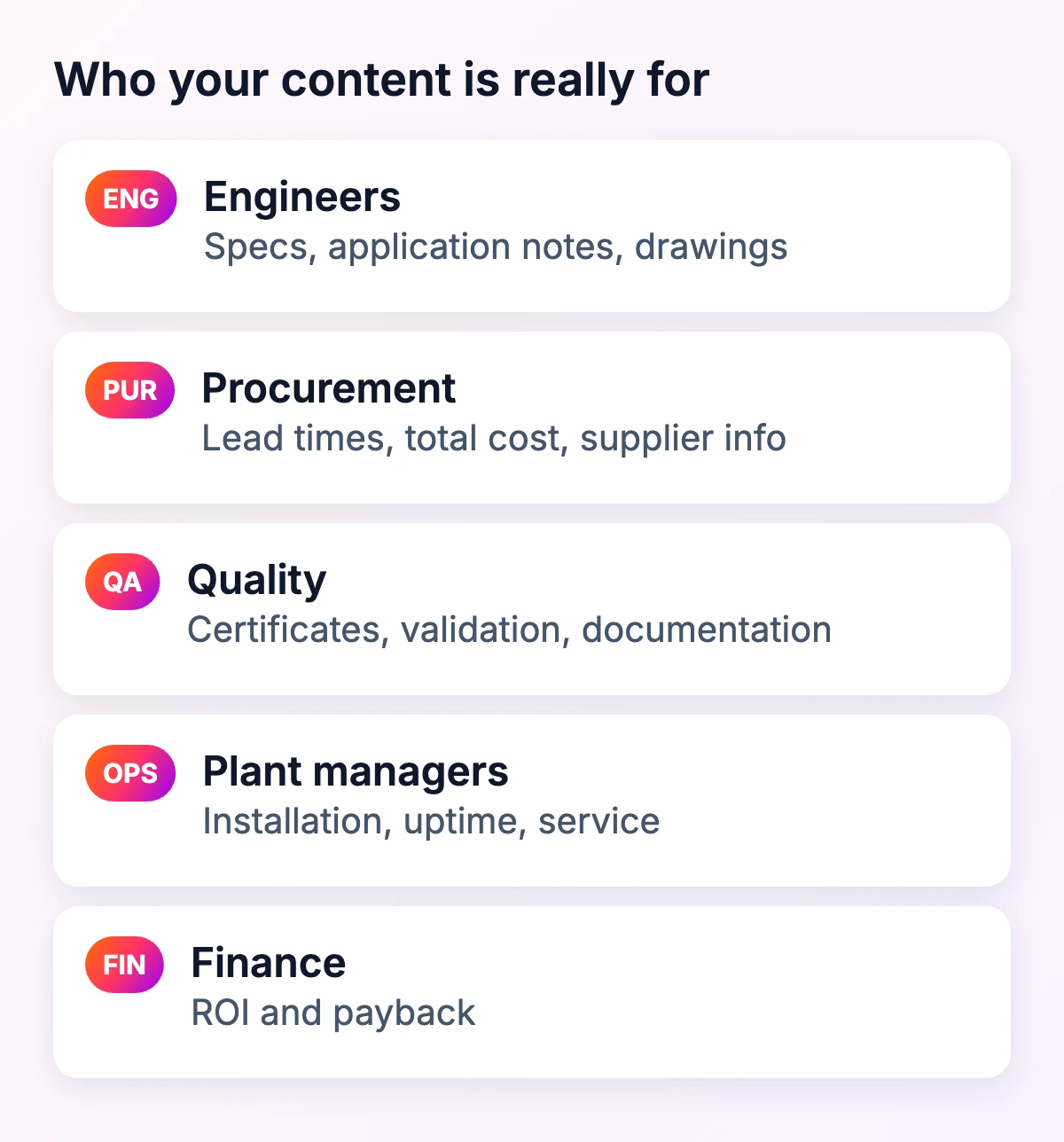
Most manufacturer content only speaks to the engineer. That’s understandable, but it leaves procurement, quality and finance to fill in the gaps themselves, and they’re often the ones who slow a decision down. A short page on total cost of ownership, or an easy-to-find set of certificates, can do a surprising amount of work. If you want to go deeper on how these people research, I wrote about how engineers and procurement teams research suppliers online.
What to create at each stage
Buyers need different things at different points. Early on, they’re still figuring out the problem. Later, they need proof you’re the right supplier. Right at the end, someone needs paperwork to sign off on.
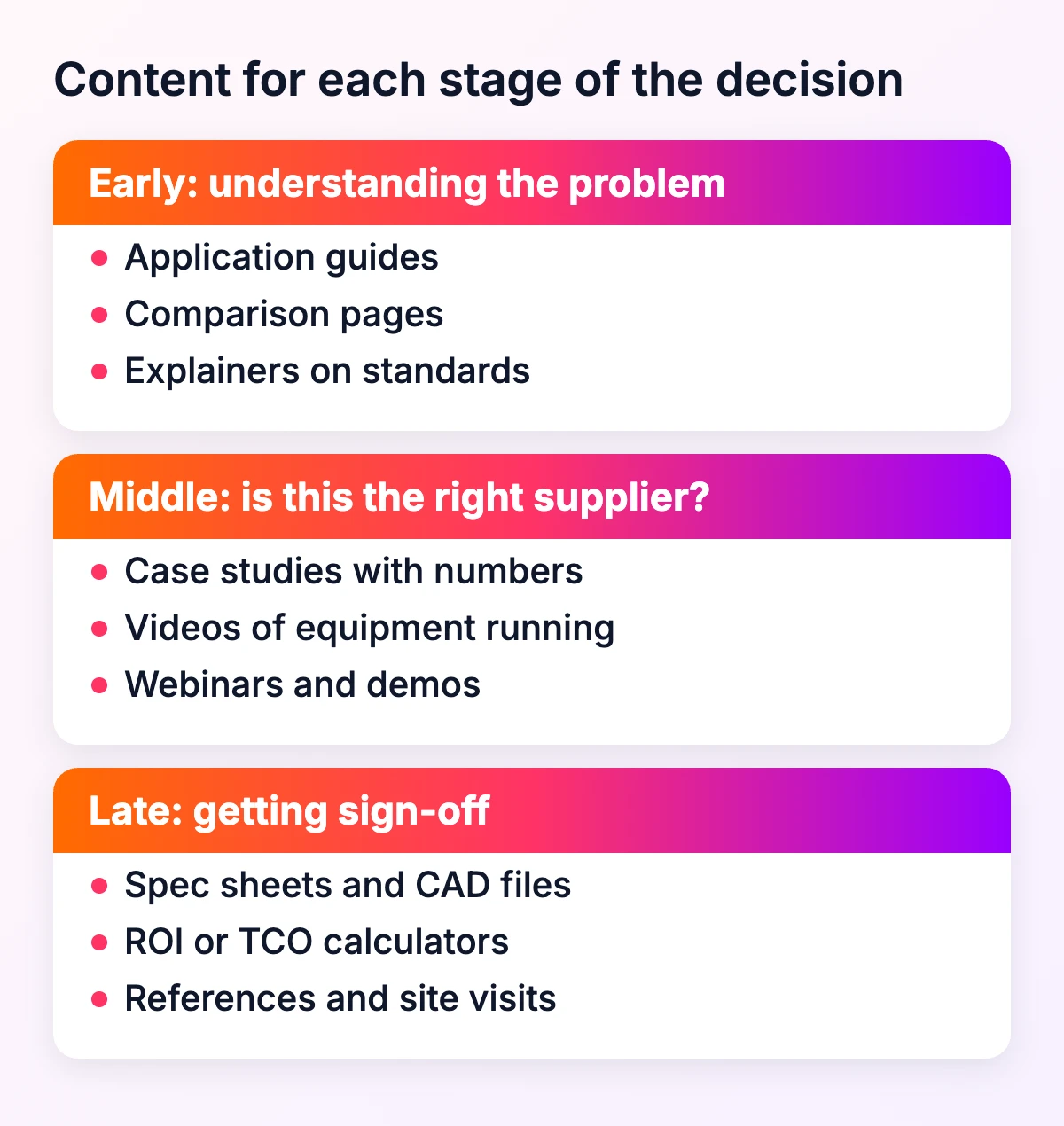
You don’t need all of this at once. If I had to pick three pieces to start with for a typical manufacturer, it would be one strong application page for your most important market, one case study with real numbers, and spec sheets anyone can download without filling in a form.
How to produce it without burning out your engineers
Your engineers know more about your market than any copywriter ever will. They also have no time, and most of them don’t enjoy writing. So don’t ask them to write. Ask them to talk.
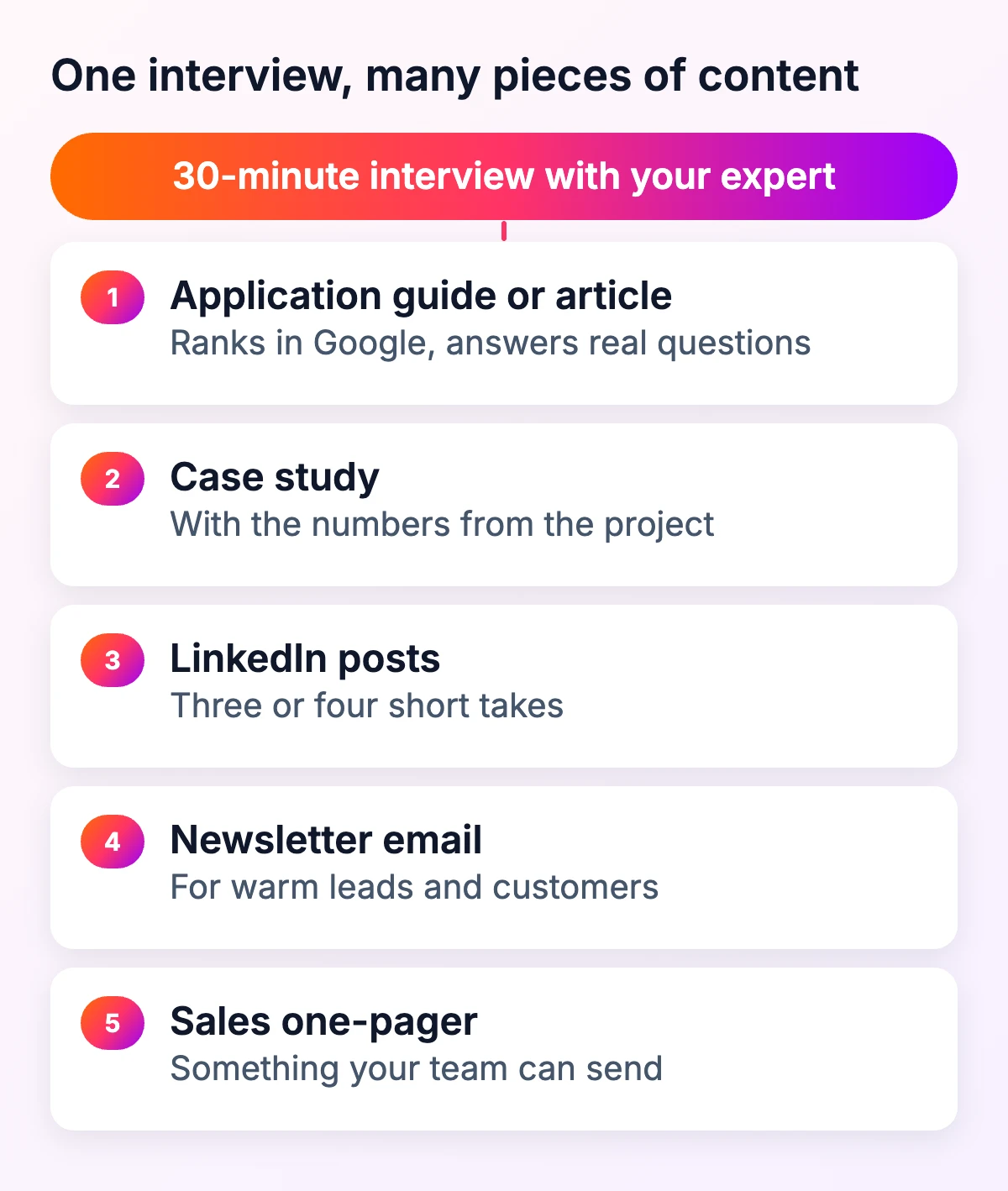
The way we usually do it at Lum Collective: a 30-minute interview with one expert, on one topic. We record it, write it up, and the expert checks the facts. From that one conversation you typically get several pieces of content.
It’s also worth filming a few short clips while you’re at it. A one-minute video of a machine actually running, with someone explaining what you’re seeing, is often more convincing than a page of text. It doesn’t need to be polished. Real is better than perfect here.
Getting it seen
Publishing is only half the work. A few channels make the biggest difference for manufacturers:
- Search: pages built around real problems and applications keep bringing in the right people for years. More in SEO for manufacturers.
- LinkedIn: turn each piece into a few short posts, ideally from the expert themselves.
- Email: a short, useful email every month or two keeps you in mind during long sales cycles.
- Your sales team: make sure they know the content exists and where to find it. You’d be surprised how often they don’t.
- Trade media: industry publications are always looking for expert stories. Getting your engineers quoted there builds credibility you can’t buy with ads.
That last one can add up. For a food processing technology company, we combined online PR, buying-cycle content and nurture emails over ten months. Here’s what that looked like in numbers:
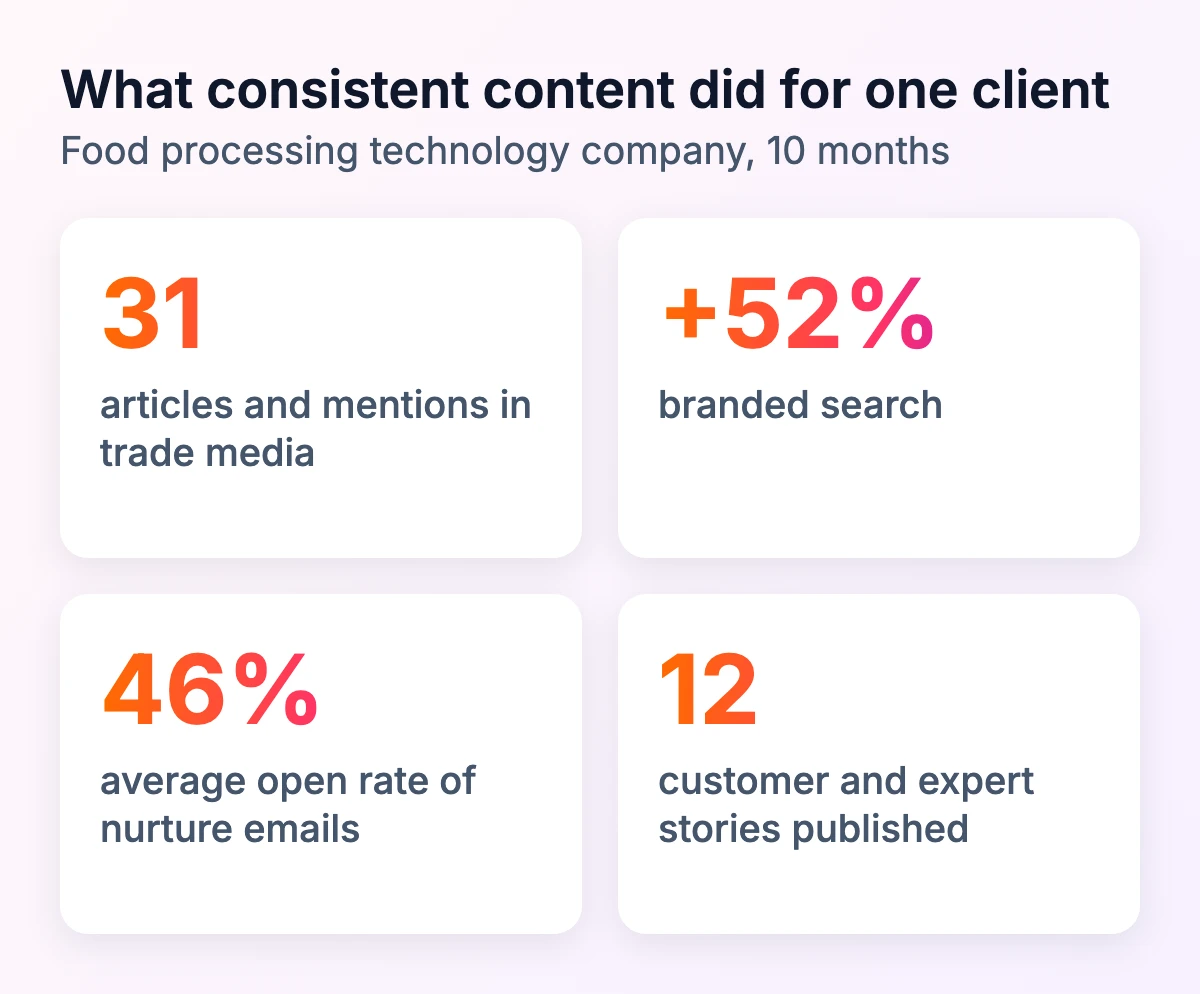
You can read the details in the case study.
Want content your sales team will actually send? We interview your experts and turn what they know into guides, case studies and pages that technical buyers read. See how we work.
A realistic rhythm
Consistency beats volume. One interview a month, turned into one solid article or case study, three or four LinkedIn posts and one email, is enough for most manufacturers to see a difference within a year. If you can do two a month, great. If you can only do one every six weeks, that’s still far better than three posts and silence.
How to measure content marketing
Look at it from two angles. On the marketing side: are your application and problem pages getting found (Search Console is your friend here), and are people moving on to request a quote, a sample or a call? On the sales side: is the content being used? Ask your team which pieces they send most and which questions are still missing. That second list is your content plan for the next quarter.
Mistakes I see a lot
- Writing about the company and the product instead of the buyer’s problem.
- Asking engineers to write, then waiting forever.
- Publishing and never sharing it with sales.
- Hiding the useful stuff in PDFs or behind forms.
- Starting with a big content calendar instead of three really good pieces.
- Stopping after a few months because “nothing is happening yet”.
Where to start
Ask your sales team for the questions they hear most, pick the one that comes up in the most valuable conversations, and book a 30-minute interview with the person who answers it best. That’s your first piece. For how content fits with everything else, have a look at our industrial marketing strategy in 8 steps, lead generation for manufacturers and the overview in marketing for manufacturing companies.
Frequently asked questions
It’s creating useful material such as application guides, case studies, comparison pages, spec sheets and short videos that helps industrial buyers understand a problem, compare suppliers and justify a decision internally. It supports both search visibility and your sales team.
Application pages, case studies with real numbers, comparison pages, easy-to-download spec sheets and short videos of equipment running tend to work best, because they answer the practical questions engineers, procurement and quality teams have.
Interview them instead of asking them to write. A 30-minute conversation on one topic, written up and fact-checked by the expert, can turn into an article, a case study, LinkedIn posts, an email and a sales one-pager.
Consistency matters more than volume. One good piece a month, reused across your website, LinkedIn, email and sales, is enough for most manufacturers to see results within a year.
Track whether your application and problem pages are found in search, whether visitors request quotes, samples or calls, and whether your sales team actually uses the content in conversations with prospects.