
Most export plans I see start with a translated brochure and a stand at a show in Germany. Sometimes a distributor too. The website gets a language switcher a few months later, usually after someone in sales complains.
I get why. Exporting is expensive and the website feels like the cheap part. But it’s often the first thing a buyer in a new market sees of you, long before they meet anyone on your team. So this is the export content marketing checklist I’d work through first as a B2B manufacturer. It isn’t exhaustive. It’s the stuff that, in my experience, gets skipped. (If you’re newer to all this, start with our guide to manufacturing marketing.)
Start with one or two markets, not ten
It’s tempting to launch five languages at once, because the CMS makes it look easy. I wouldn’t. Every language you add is another site to keep up to date, with its own keywords, its own enquiries and someone who can actually answer them.
Pick markets with some evidence behind them: where you already have customers, where distributors keep asking for material, where the regulation suits your product, where competitors aren’t strong yet. Gut feeling is a fine starting point. It shouldn’t be the whole decision.
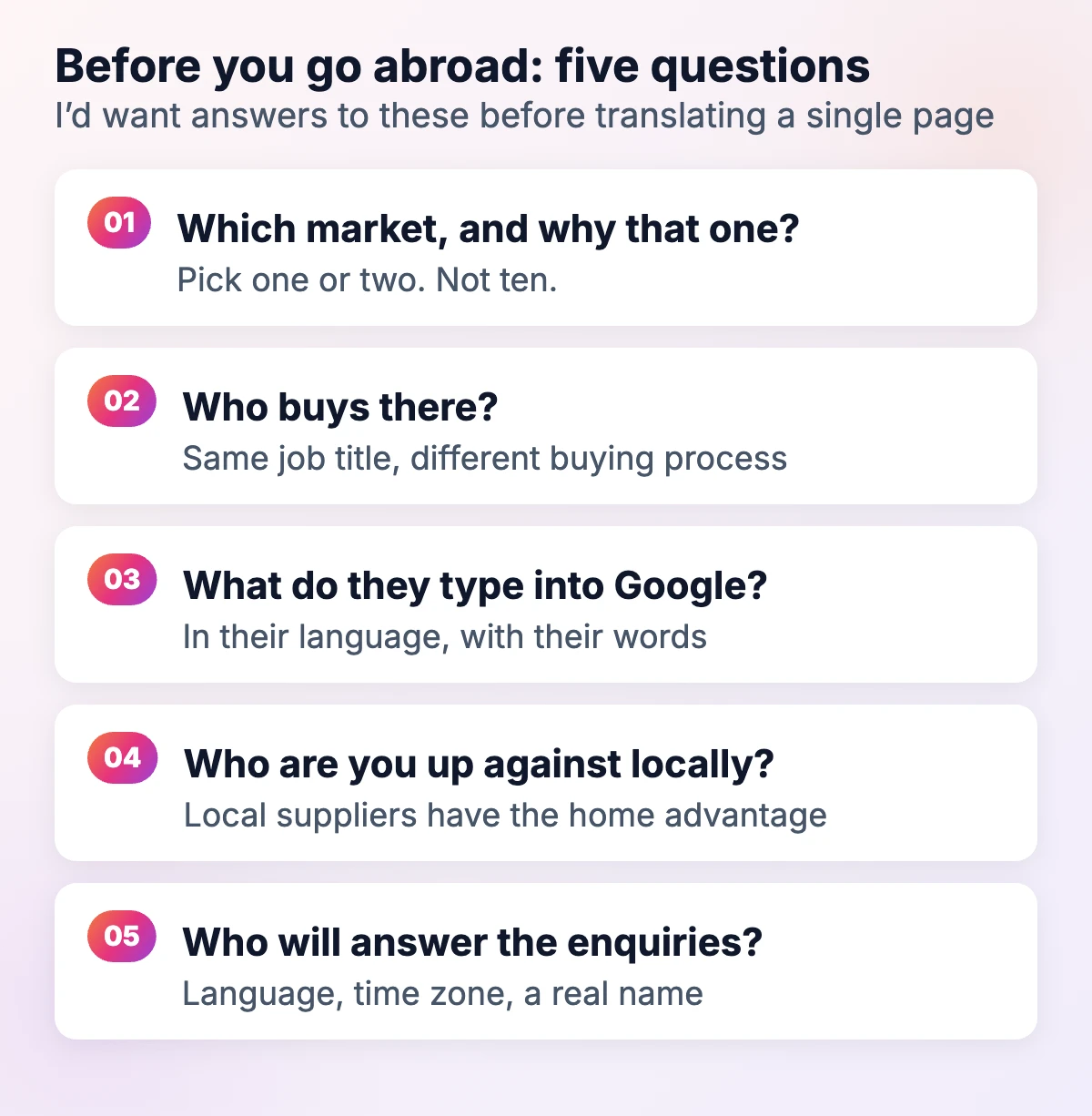
That last question catches a lot of companies out. An enquiry in Polish that sits in a shared inbox for a week does more damage than having no Polish page at all.
Research keywords in each language (yes, again)
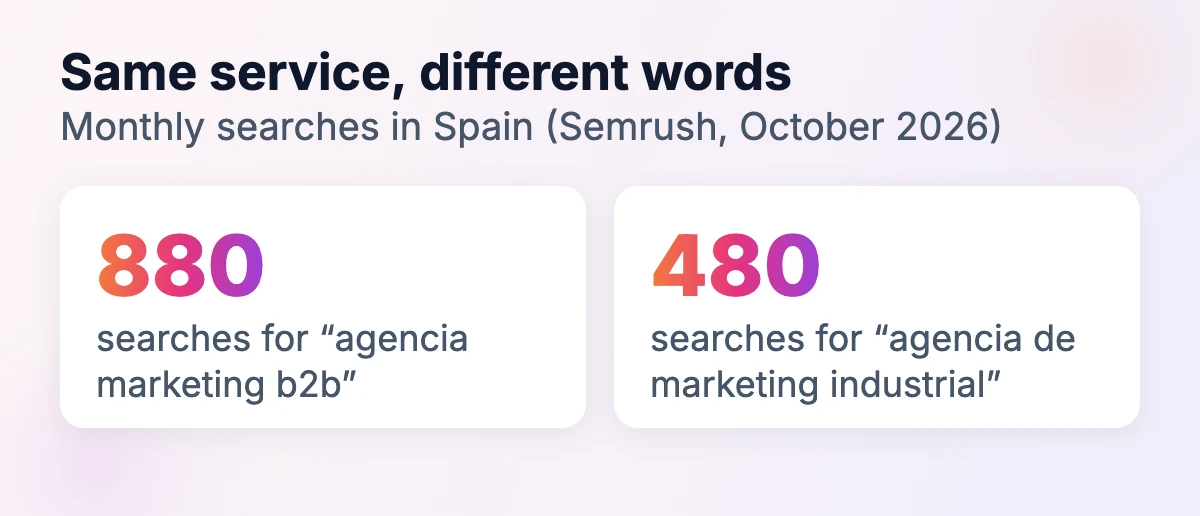
This one’s a bit personal. When we researched keywords for our own Spanish pages, I assumed people would look for an “agencia de marketing industrial”. Some do. But according to Semrush, “agencia marketing b2b” gets almost twice as many searches in Spain. Same service, different words. If we’d just translated our English pages, we’d have optimised for the smaller term.
Technical terms are even trickier. Engineers in different countries use different names for the same process, the same standard, sometimes the same machine part, and a translator won’t always know that. Your local sales people or distributors will. Ask them which words customers really use. I wrote more about where good keywords come from in SEO for manufacturers.
Localise the website, don’t just translate it
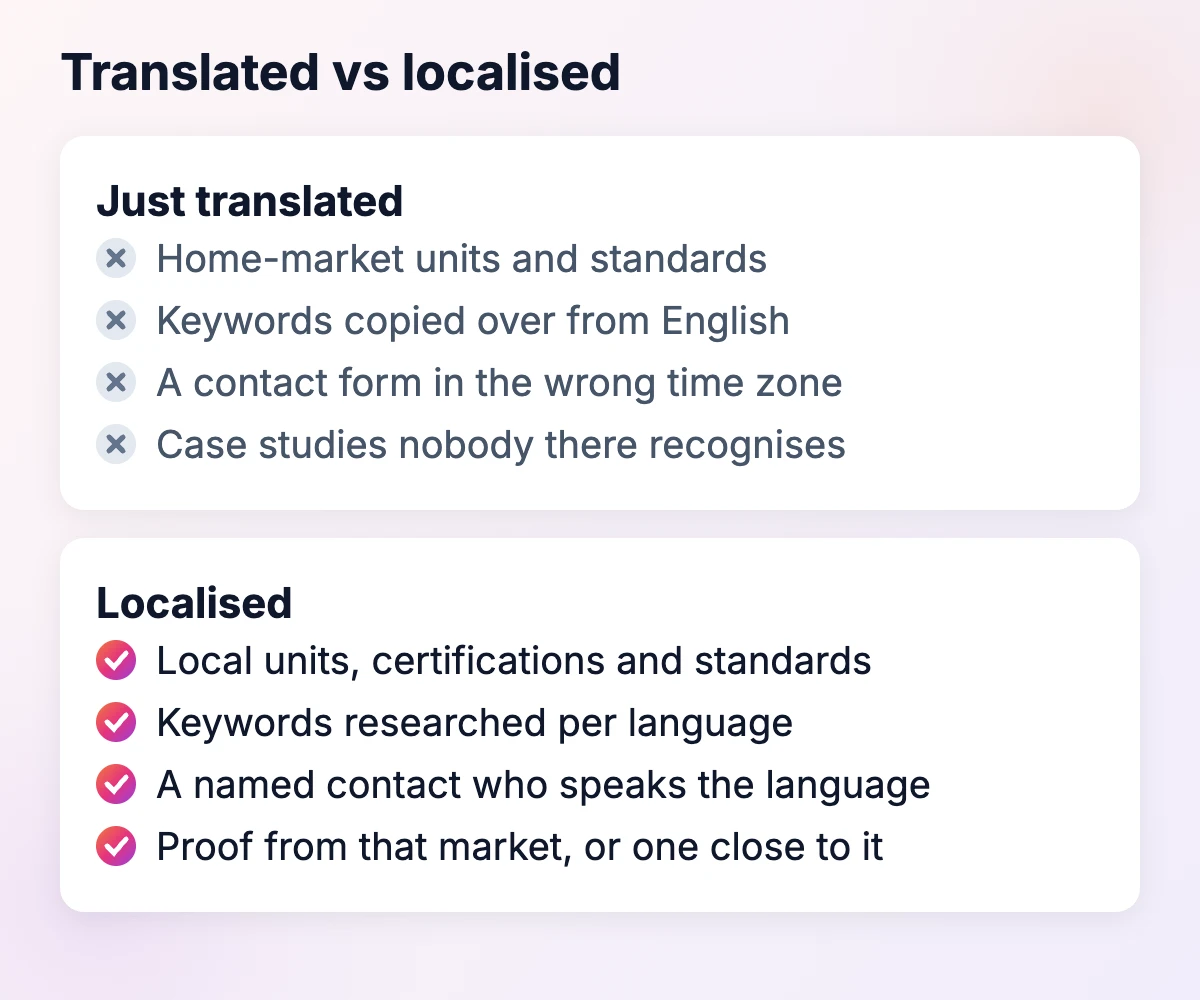
Translation gets the words right. Localising means asking what a buyer in that country needs to see before they trust you: units (bar or psi?), the certifications they look for, how lead times are usually discussed, and proof they’ll recognise.
A few technical basics too, because they really do matter for international SEO:
- Separate URLs per language, like /es/ or /de/. Not one page that switches language with a cookie.
- hreflang tags, so Google shows the right version in the right country. Google’s guide to localised versions is surprisingly readable.
- No automatic redirects based on someone’s IP. Let people (and Google) choose.
- Translated meta titles, alt text and URLs, not only the body copy. These get forgotten all the time.
Content that travels well
Some content works in almost any market once it’s properly translated: application pages built around a problem (cleaning validation, shelf life, energy use), technical FAQs, short videos of the machine actually running. Other content barely travels. A case study from a customer nobody in that country has heard of is still useful, sure, but it won’t carry the same weight as a local reference.
And please don’t gate the spec sheets. I’d say that for any market, but it matters even more abroad, where buyers don’t know you yet and are less likely to hand over their details to a company they’ve never heard of.
If I’m already seriously considering your product, making me hand over my details just to see basic technical information creates unnecessary friction.
Lot, Lum Collective
Give your distributors something to work with
In a lot of export markets the distributor is your marketing team, whether you planned it that way or not. They’ll talk about your product with whatever material they’ve got. If that’s a PDF from 2019 and a logo, that’s what your customers see.
A simple distributor kit goes a long way. A short presentation, good product photos, application one-pagers in their language, the questions your sales team hears most, a couple of LinkedIn posts they can adapt. Ask them what’s missing. They usually know exactly.
Trade shows abroad: plan the before and the after
International shows are often the biggest single export cost, and the follow-up is where things fall apart, especially when the leads come in three languages and nobody has time to translate the notes. I’ve written about following up on trade show leads separately. Short version: decide who follows up with which country before you fly.
If you’re planning next year already, here’s my calendar of food and manufacturing trade shows in Europe for 2027.
Test a market on LinkedIn before you commit
LinkedIn lets you target by country, industry and job title, which makes it one of the cheaper ways to test a new market before you book a big stand. Run a small campaign to a localised landing page and see who clicks, and more importantly who gets in touch. It’s not a perfect signal. It is a cheap one. More on that in LinkedIn marketing for manufacturers.
Measure per market
Report enquiries per country, not just traffic. A spike in visits from Brazil because one blog post took off there doesn’t mean much if you can’t ship to Brazil. Per market, I’d look at qualified enquiries, the pages they came in through, which distributor or show they’re linked to, and how long they take to become a real opportunity.
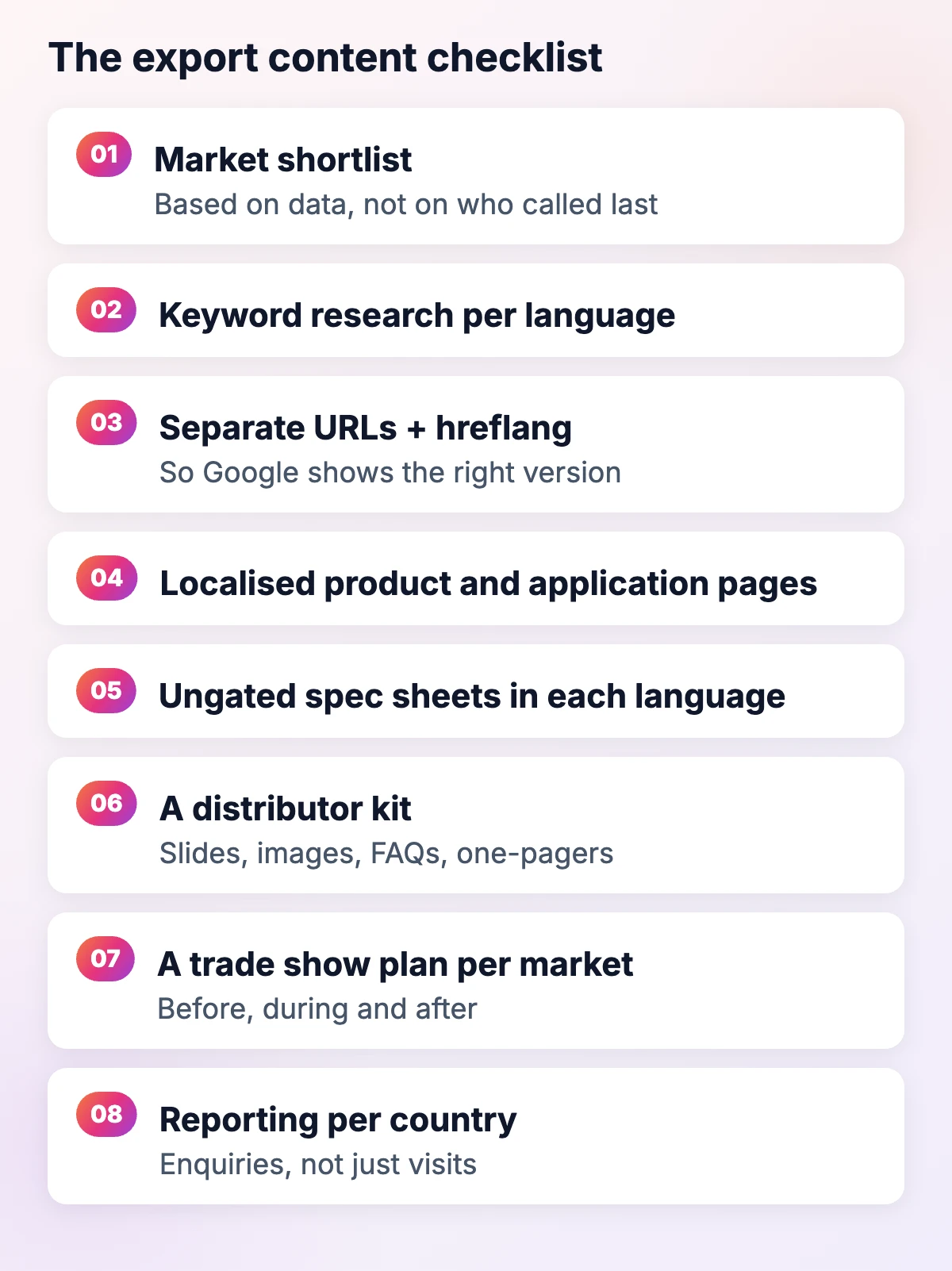
Not every item will apply to you. The ones that hurt most to skip, in my experience, are 02, 05 and 06.
Frequently asked questions
It’s creating and adapting content (website pages, technical documents, case studies, emails, social posts) for buyers in your export markets, in their language and around the problems they search for. It goes beyond translation: keywords, proof and contact details all change per market.
Usually not. Start with the pages that matter most for that market: the homepage, key product and application pages, contact details and spec sheets. Add more as you learn what buyers there look for.
Not necessarily. Most manufacturers do well with one domain and language folders (/es/, /de/) plus hreflang tags. Separate country domains can make sense for very big markets, but each one needs its own authority built from scratch.
Look at where you already have customers or distributor interest, how competitive the market is, which regulations apply and whether you can handle enquiries in that language. Then test with low-cost activity, like a LinkedIn campaign to a localised landing page, before committing to a big trade show.
Planning to sell in a new market? Talk to Lum Collective about getting your website and content ready before you go.