

Most SEO advice for the food industry is written for restaurants, recipe sites and consumer brands. If you build processing lines, packaging machines, ovens, conveyors or inspection systems, almost none of it applies. Your buyers don’t search for “best snacks 2026”. They search for a solution to a production problem, often with very specific words, and often only a few times a month.
That doesn’t make SEO less useful for food equipment suppliers. It just means it works differently. Here’s how we approach it for clients in food tech and food processing.
For B2B food equipment, SEO isn’t about traffic volume. It’s about being the supplier an engineer finds when they search for the exact problem, application or standard you can help with.
Small search volumes are fine
Keyword tools will tell you that “hygienic spiral conveyor for frozen bakery” gets close to zero searches a month. That number is misleading. The few people who do search for it are often exactly the people you want: a production manager, a process engineer or a project buyer who already has a budget and a problem to solve.
One qualified visitor a week can be worth more than a thousand people reading a general article. So instead of chasing the biggest keywords, we look for terms with clear buying intent, even when the volume looks tiny. A good rule of thumb: if a salesperson would be happy to get a call from someone searching for this, it’s a keyword worth targeting.
Buyers search for problems, not products
Your product catalogue uses your internal names. Your buyers use theirs. Early in the process, they rarely know which machine they need. They know what’s going wrong or what they want to achieve:
- “reduce product loss on packaging line”
- “how to prevent cross-contamination allergens production line”
- “increase oven capacity without extra floor space”
- “metal detection vs x-ray inspection food”
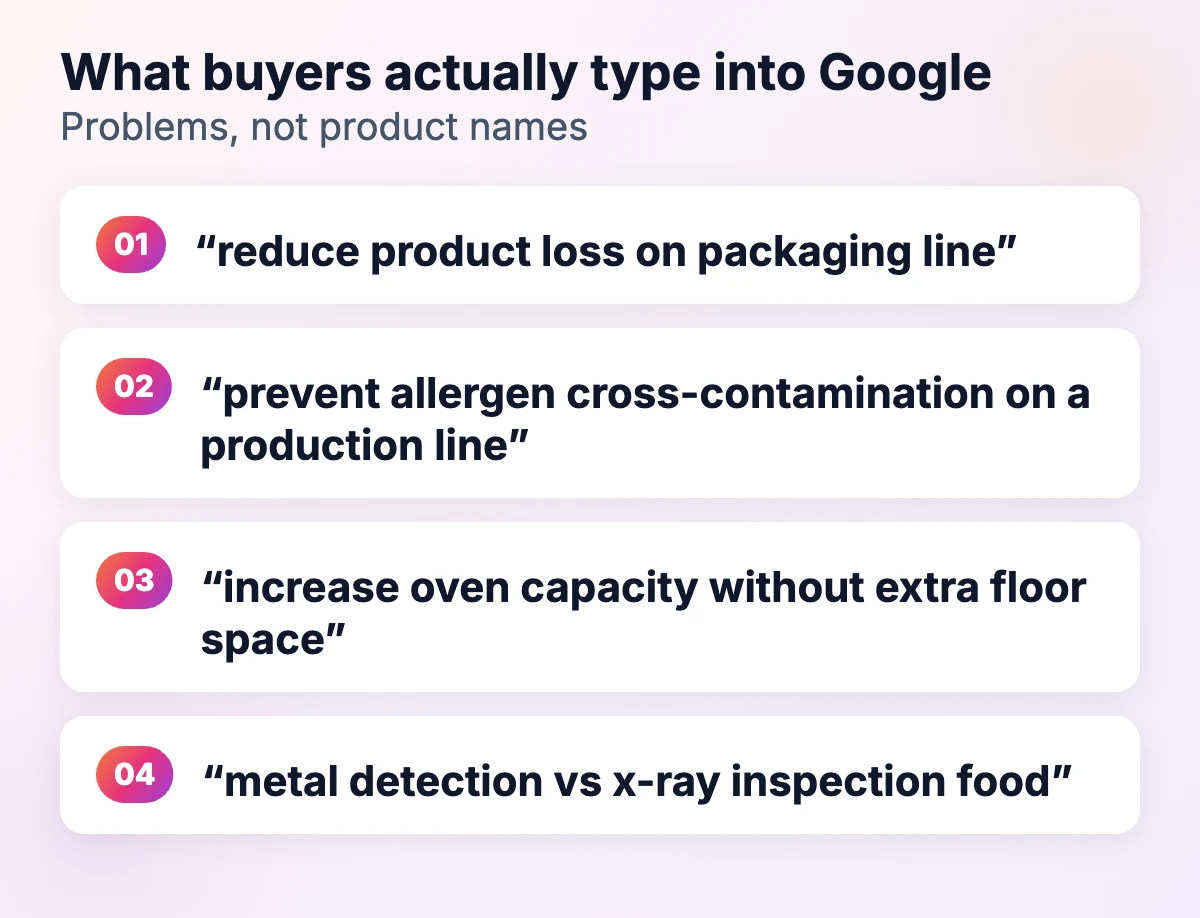
Pages built around problems like these meet buyers much earlier in their search than a product page ever will. They also give your sales team something useful to send. We cover who searches for what in more detail in how engineers and procurement teams research suppliers online.
Build application pages
An application page answers the question every buyer has: will this work for my product and my production? It’s one of the most effective page types for food equipment SEO, and most suppliers don’t have enough of them.
A good application page covers:
- The product or process it’s for, named the way buyers name it (for example “cooling of baked goods” or “portioning cheese”).
- The typical challenges in that application, and how your equipment deals with them.
- Relevant specs: capacities, hygiene class, cleaning method, footprint.
- A real example or customer story, with numbers where you have them.
- A clear next step, such as a test in your demo centre or a call with an application engineer.
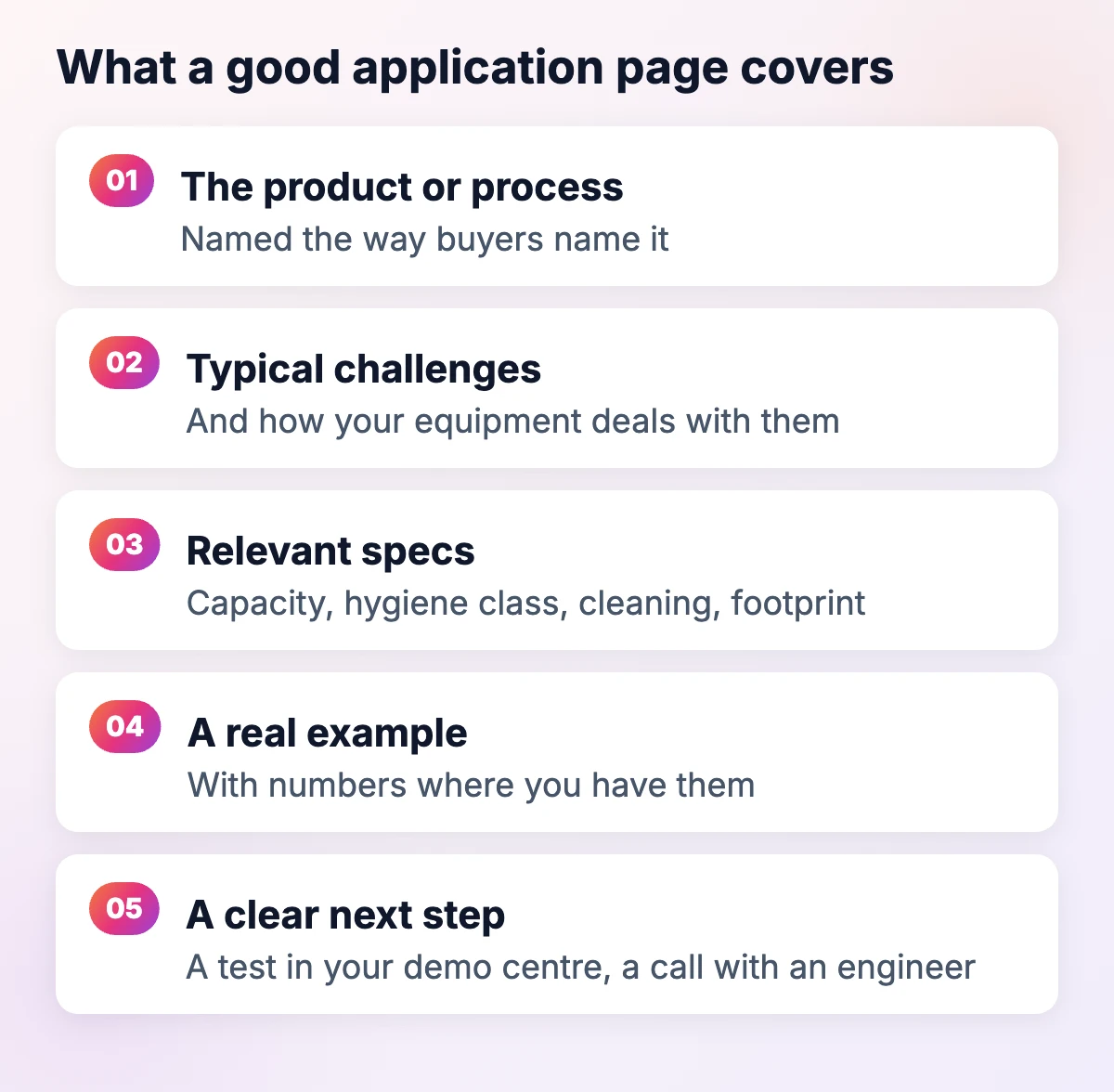
One page per application beats one long page that mentions everything. It ranks for more specific searches and it’s easier for both buyers and AI tools like ChatGPT to understand.
Get found for specs and standards
Technical buyers often search with spec language: materials, hygiene standards, certifications, cleaning methods. Think of terms like “EHEDG certified”, “3-A sanitary”, “IP69K”, “CIP cleaning” or “ATEX zone 22”. If your equipment meets a standard, say so clearly in text on the relevant pages, not only in a downloadable PDF. Search engines can’t do much with a spec sheet hidden in a brochure.
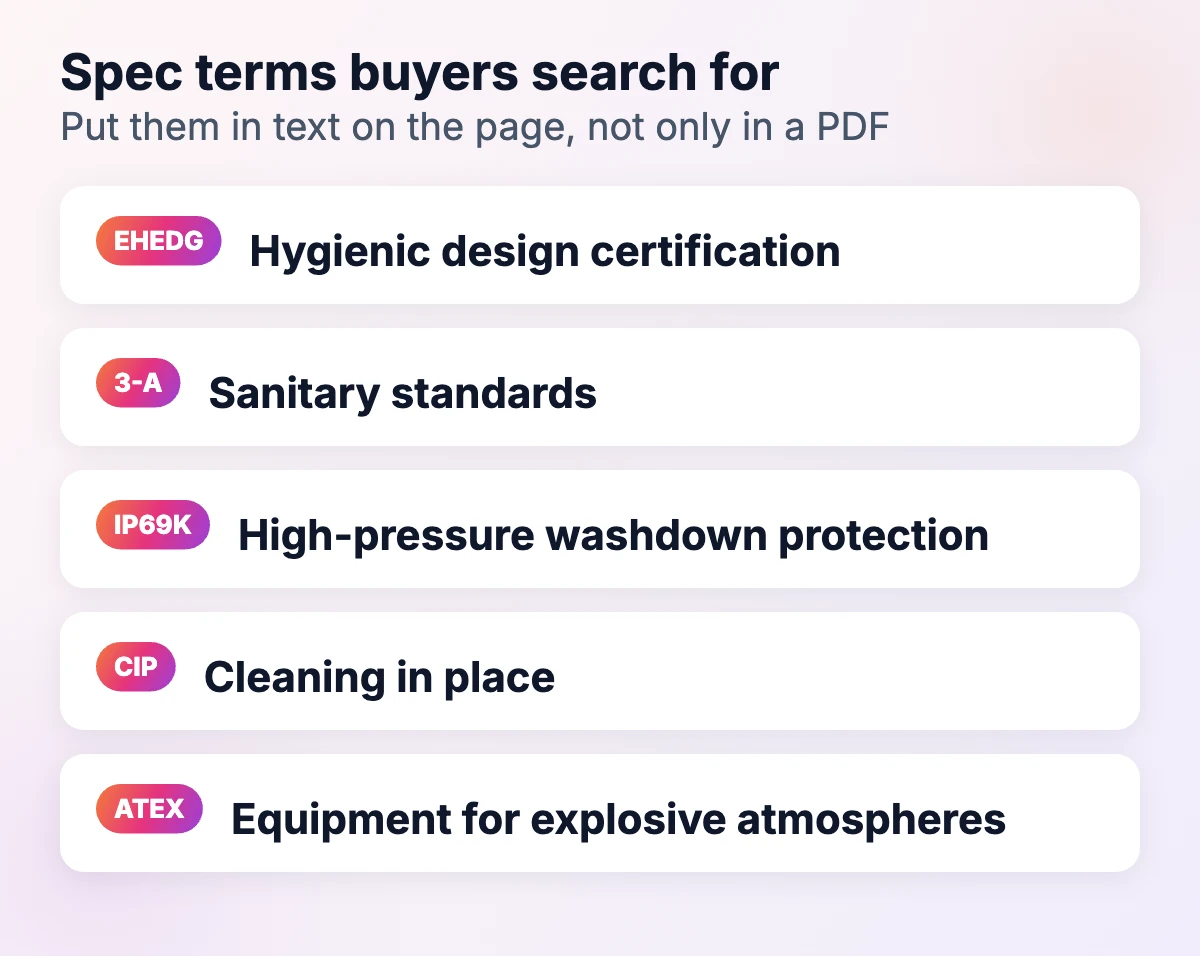
Link to the source when you mention a standard. Pointing to the EHEDG guidelines or the 3-A Sanitary Standards helps readers check what a certification actually means, and it shows you know the field.
Use your experts
The best SEO content for food equipment comes from the people who know the machines: application engineers, service technicians, product managers. They know which questions customers ask, which mistakes they make and which details matter. The challenge is that they rarely have time to write.
That’s why we interview experts instead of asking them for drafts. A 30-minute conversation usually gives enough material for an article, an FAQ section and a few updates to existing pages. It also keeps the content accurate, which matters a lot in a technical industry. Google’s own guidance on helpful, people-first content puts a lot of weight on first-hand expertise, and this is the easiest way to show it.
Selling equipment to food producers? We help food tech companies get found by the engineers and buyers who are already looking. See how our B2B SEO works.
Fix the basics first
Before writing anything new, check the pages you already have. In our experience, food equipment websites often have a few technical issues holding them back:
- Product information only in PDFs or images, so search engines can’t read it.
- One page per product family, with no separate pages for applications or industries.
- Several language versions without proper hreflang tags, so the wrong version shows up in the wrong country.
- Slow pages full of large, uncompressed images and videos.
Fixing these is rarely glamorous, but it often brings quicker results than new content.
What results to expect
B2B SEO for food equipment takes time. Expect three to six months before you see a clear rise in organic enquiries, and longer in very competitive niches. Early signs show up sooner: more impressions and better positions for your priority terms in the Google Search Console Performance report.
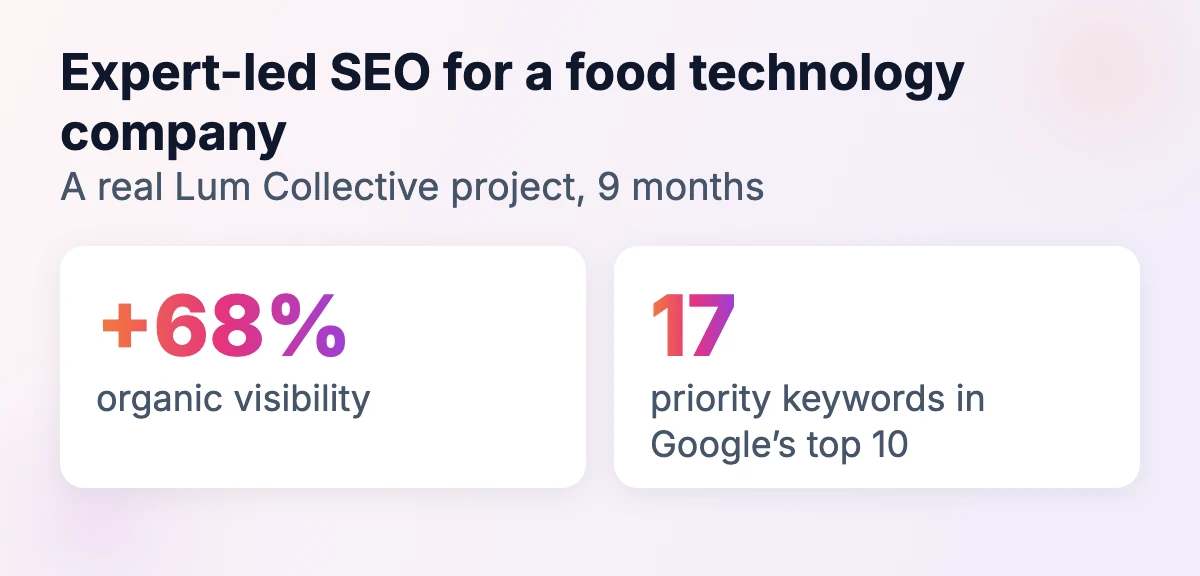
For one European food technology company, nine months of expert-led content and better landing pages led to 68% more organic visibility and 17 priority keywords in Google’s top 10. Read the full food tech SEO case study.
Frequently asked questions
Yes. Search volumes are small, but the people searching are often qualified buyers with a real project. A handful of the right visitors can be worth more than a lot of general traffic.
Start with application pages for your most important products and customers, then pages for the industries you serve. Update existing product pages so specs and standards are in text, not only in PDFs.
If you sell in several countries, yes. Buyers search in their own language, and each version needs its own page with correct hreflang tags. Write for each market rather than translating word for word.
Usually three to six months before organic enquiries clearly increase. Rankings and impressions often start moving within the first months.