


I’ve read a lot of marketing plans. The long ones usually have a SWOT analysis, three personas with stock-photo faces and a channel list that runs from TikTok to trade magazines. They get presented in January, everyone nods, and by March nobody can find the file.
Most manufacturing marketing plans don’t need to be long. They need to be specific enough that your team knows what to do next month, and honest enough that sales recognises the customers in them. Below is how I’d put one together, with a one-page template you can copy. If you haven’t settled the bigger direction yet, our industrial marketing strategy guide comes first. This post is about what actually happens this year, who does it and how you’ll know it worked.
The eight parts I’d include
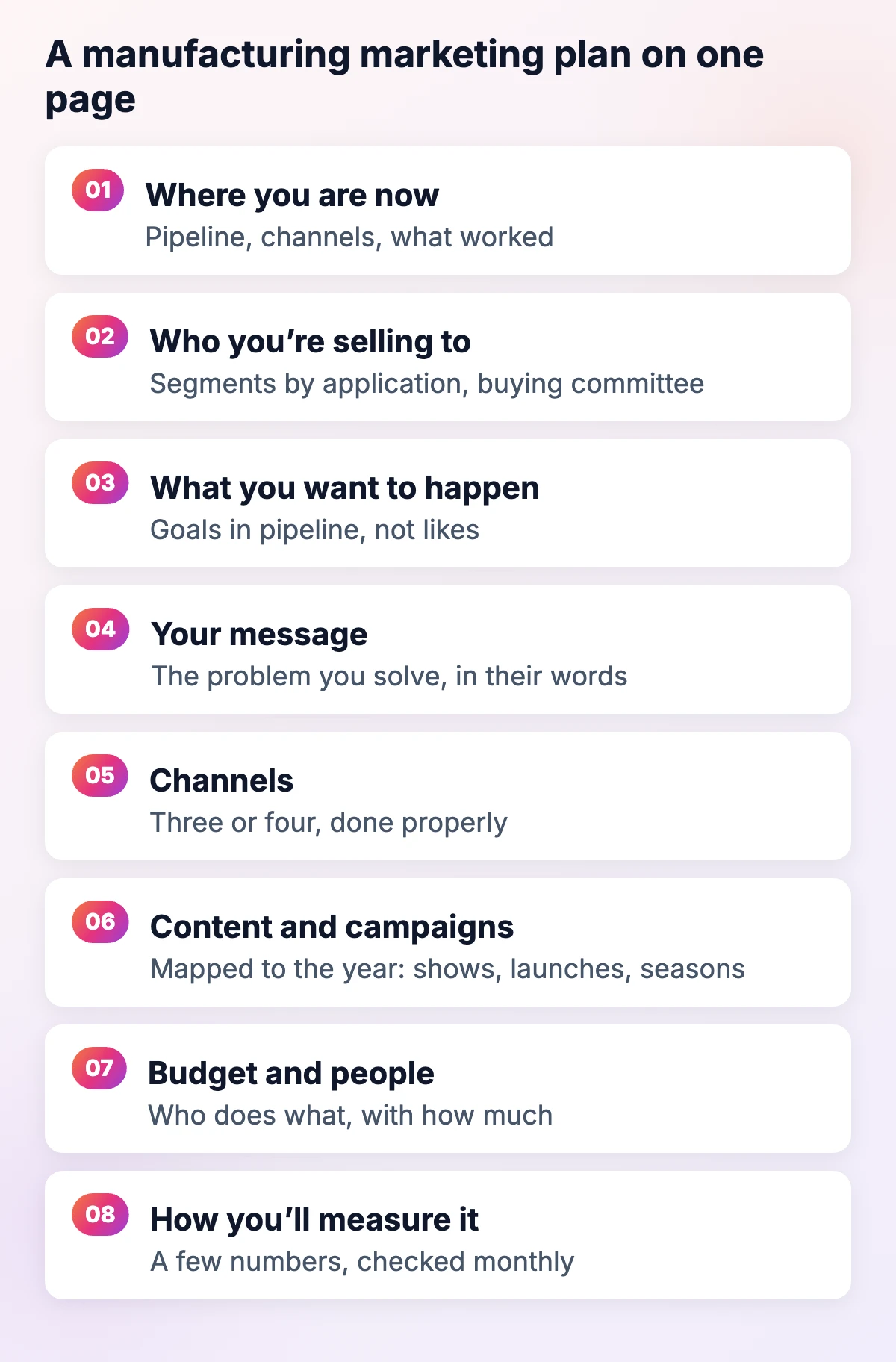
1. Where you are now
Start with what’s true, not with what was in last year’s plan. Where did your qualified enquiries come from? Which shows brought real opportunities? What does your website actually rank for? If nobody knows, that’s useful information too. It probably means tracking is job number one.
2. Who you’re selling to
Segment by application or industry, not only by company size. A bakery and a dairy might buy the same type of equipment for completely different reasons. For each segment, write down who sits on the buying committee: production, quality, maintenance, procurement, sometimes the plant manager. They each want something different from you.
3. What you want to happen
Goals like “increase brand awareness” are impossible to argue with, which is exactly the problem. I’d rather see something like “30 qualified enquiries from the dairy segment” or “10 opportunities from the spring show”. You might miss the number. At least you’ll know you missed it.
4. Your message
This is where a lot of manufacturers slip into describing the product instead of the problem it solves. I see it all the time.
Manufacturing companies know their products inside out, so websites often become very technical very quickly. But the buyer still needs to understand: is this relevant to me, why is it better, and why should I trust you?
Lot, Lum Collective
5. Channels
Three or four, done properly. For most manufacturers I’d look at SEO and content, one or two trade shows, LinkedIn, and email to the people you already know. Paid search if people search for exactly what you make. I go through the options in more detail in manufacturing lead generation.
6. Content and campaigns
Map them to the year. Trade shows, product launches, your customers’ busy seasons (food producers rarely want to talk about new equipment in the middle of their peak), budget cycles. Content should feed the campaigns rather than run alongside them on its own schedule.
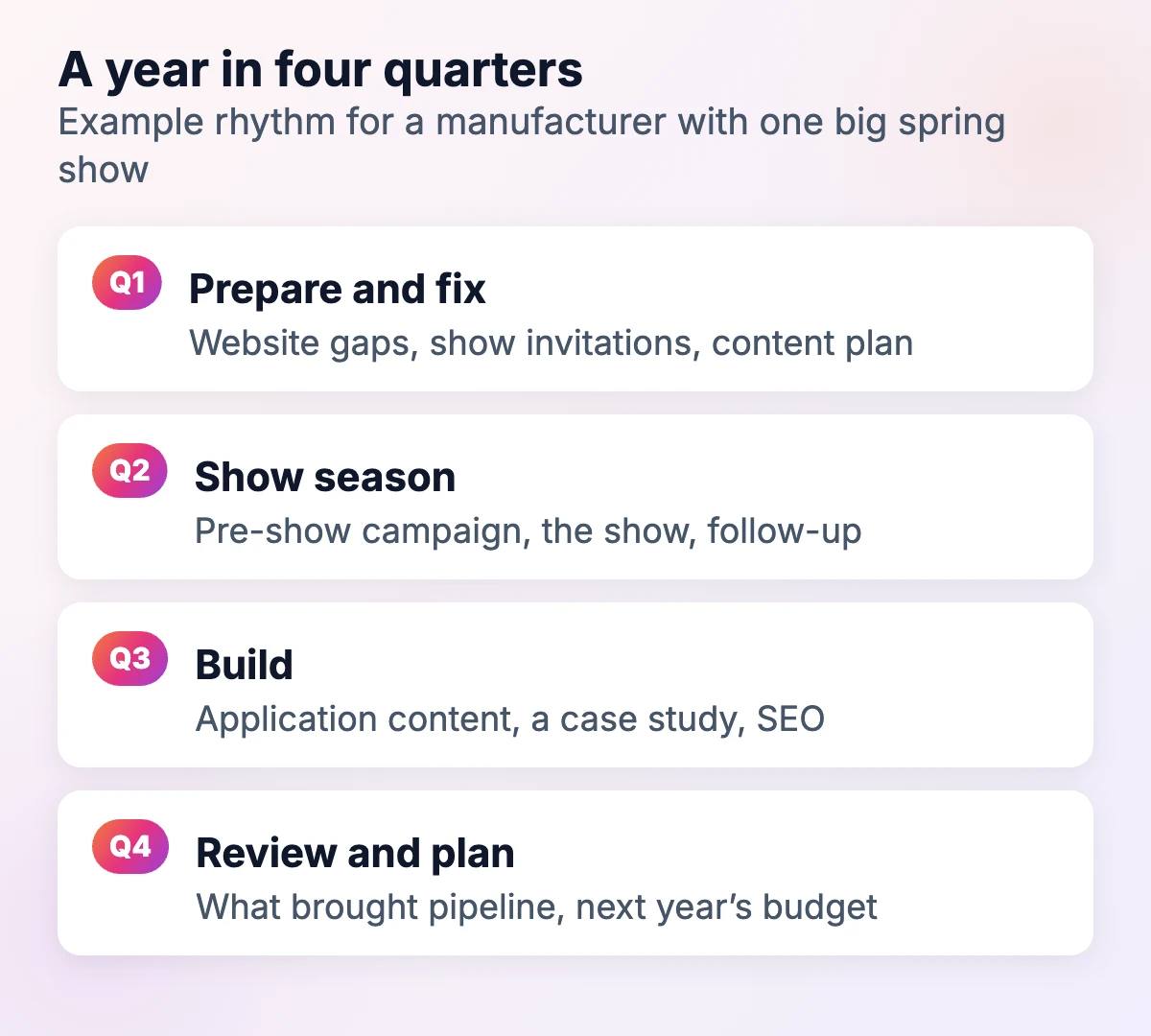
That’s an example rhythm, not a rule. If your big show is in October, shift everything.
7. Budget and people
Who does what, and how many hours does it really take? Plans tend to fudge this part. A plan that needs 40 hours a week from one part-time marketer isn’t a plan, it’s a wish list. Be honest, and if something has to go, decide now which thing.
8. How you’ll measure it
A handful of numbers that connect to pipeline. More on that further down.
Where marketing plans usually go wrong
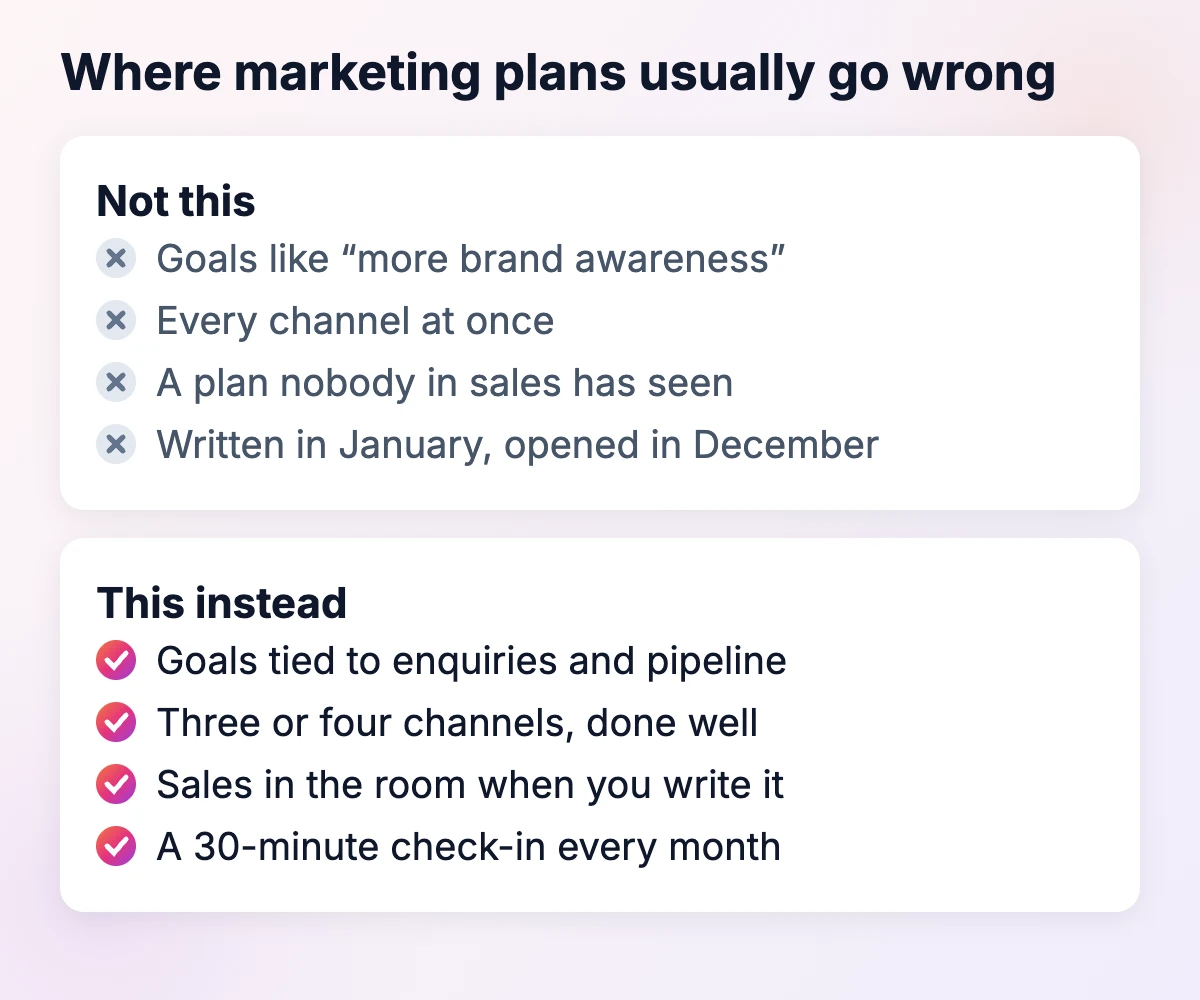
The second one is the most common, I think. Everyone wants to be everywhere. But every channel needs content, attention and someone who actually looks at the results, and spreading a small team over eight channels mostly means doing eight things badly.
And get sales involved. Not to sign it off at the end, but while you’re writing it. They know which customers are worth chasing and which objections keep coming back.
The one-page marketing plan template
Copy this into a doc or a spreadsheet and fill it in. If one section takes more than a few lines, that’s usually a sign you haven’t decided yet.
| Section | What to write | Your answer |
|---|---|---|
| Where we are | Last year’s qualified enquiries by source. What worked, what didn’t. | |
| Target segments | 2–3 segments by application or industry, plus the roles on each buying committee. | |
| Goals | Numbers tied to enquiries, opportunities or pipeline. Per segment if you can. | |
| Message | The problem you solve for each segment, in their words. The proof you can show. | |
| Channels | 3–4 channels, and why each one. | |
| Calendar | Shows, launches and campaigns per quarter. | |
| Budget and people | Who owns each channel and roughly how many hours or euros it needs. | |
| Measurement | The 4–5 numbers you’ll check every month, and who checks them. |
An example (made up, to show the level of detail)
This isn’t a client. It’s an invented maker of dairy processing equipment, just to show how short each answer can be.
| Section | Made-up example |
|---|---|
| Where we are | Most enquiries came through distributors and one national show. The website brings in very few. |
| Target segments | Mid-sized cheese and yoghurt producers. Committee: production manager, quality manager, maintenance, plant director. |
| Goals | 25 qualified enquiries from the website this year; 8 opportunities from the spring show. |
| Message | Shorter cleaning cycles without compromising hygiene, with validation data to back it up. |
| Channels | SEO and application content, one trade show, LinkedIn, email to existing contacts. |
| Calendar | Q1 website fixes and show invitations. Q2 show and follow-up. Q3 two application pages and a case study. Q4 review. |
| Budget and people | Marketing manager (half-time) owns the plan. Sales follows up show leads within 48 hours. Agency support for content and SEO. |
| Measurement | Qualified enquiries, opportunities, pipeline influenced, top enquiry pages. Checked the first Monday of every month. |
Check it monthly, not once a year
A plan you only open in December can’t change anything. I’d put a 30-minute check in the calendar every month: what came in, what we did, what we said we’d do and didn’t. Short meeting. Usually uncomfortable for five minutes, then useful.
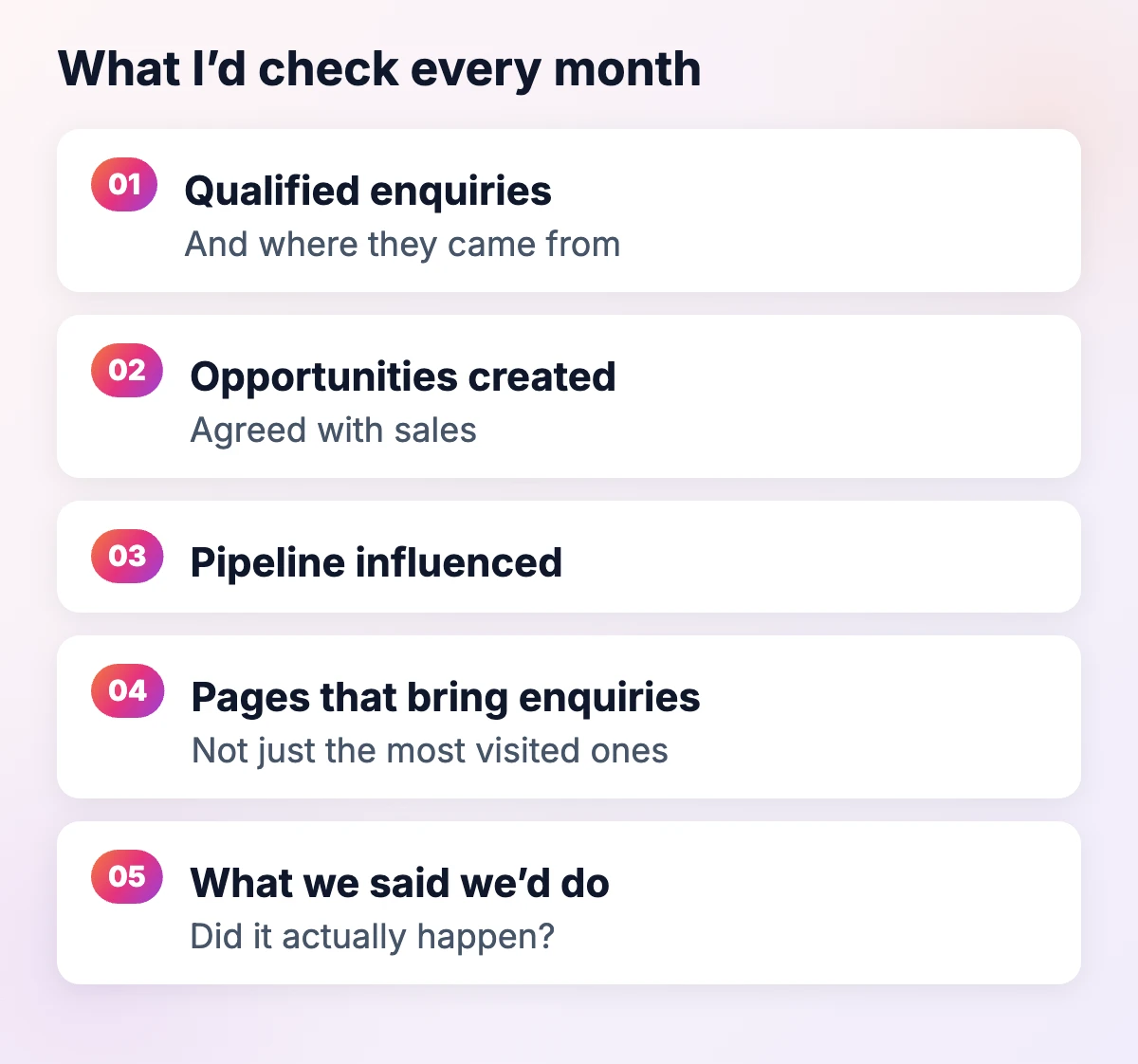
Rankings, followers and traffic are fine to keep an eye on. They’re early signals, though. I wouldn’t stop there.
Frequently asked questions
At minimum: your current situation, target segments and their buying committees, goals tied to pipeline, your core message, a small set of channels, a content and campaign calendar, budget and owners, and how you’ll measure progress.
As short as it can be while still being specific. A one-page summary that everyone reads is more useful than a 40-page document nobody opens. More detail can live in separate channel plans.
There’s no single right number. It depends on your margins, your growth goals and how much of your pipeline already comes from marketing. I’d start from the goals and the channels you need to reach them, then check whether the budget is realistic, rather than starting from a percentage of revenue.
Review progress every month and adjust the plan every quarter. Rewrite it once a year, ideally before budgets are set.
Want a second pair of eyes on your plan? Talk to Lum Collective. We’re happy to tell you what we’d cut.