


When a manufacturer tells me they need more leads, my first question is always: more of what? Because in manufacturing, a lead can be anything from a student who downloaded a brochure to a plant manager with a signed-off budget and a deadline. Counting them as the same thing is how marketing teams end up celebrating numbers that sales quietly ignores.
So this isn’t a guide to getting as many leads as possible. It’s about getting the right ones, from the places industrial buyers actually look, and making sure they turn into real conversations.
The short version: agree with sales what a good lead is, make it easy for the right people to raise their hand (without hiding everything behind forms), and follow up fast. Then measure leads by what they turn into, not by how many there are.
What counts as a lead in manufacturing?
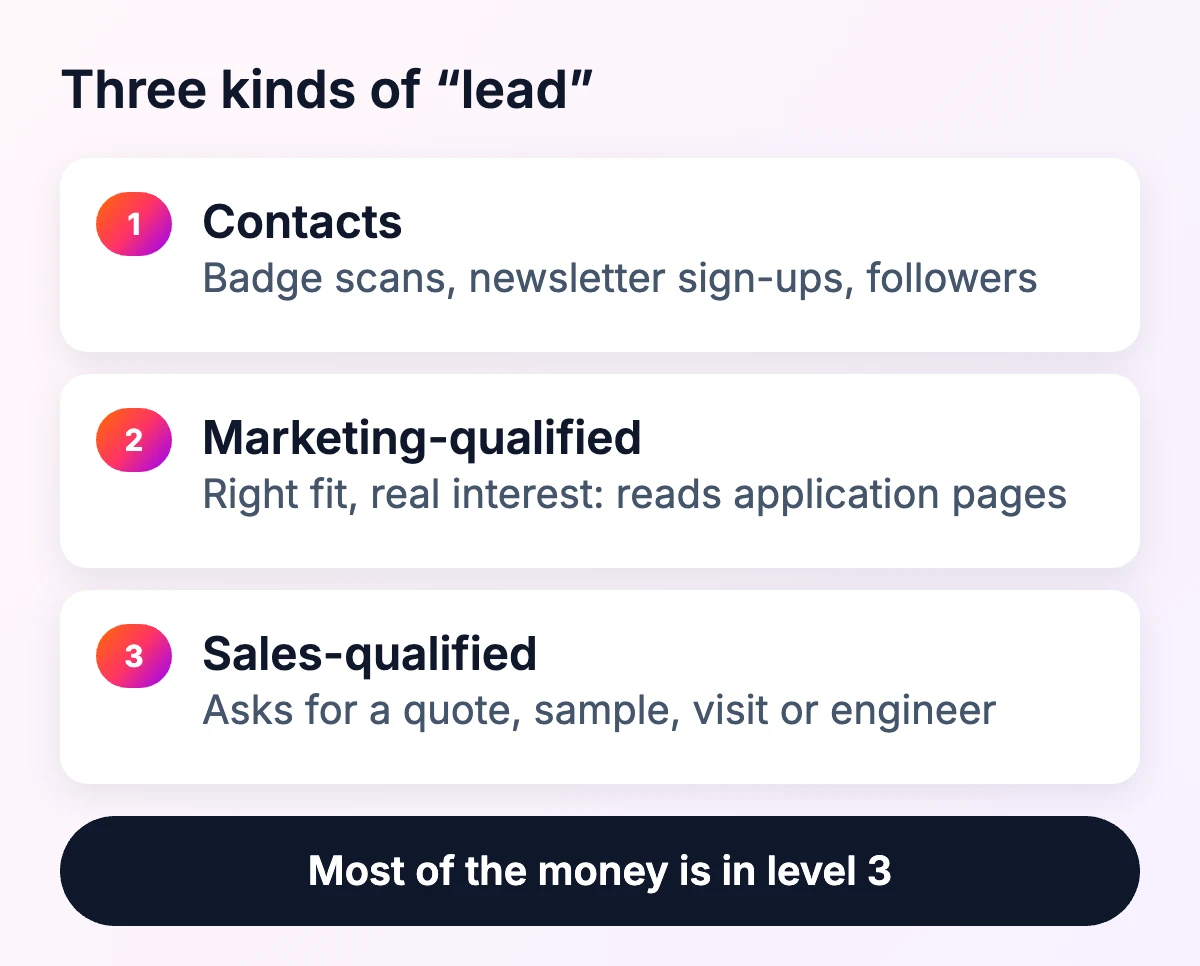
Roughly, there are three levels, and it helps to name them:
- Contacts: people who know you exist. A trade show badge scan, a newsletter sign-up, someone who follows you on LinkedIn.
- Marketing-qualified leads: people who fit your market and have shown real interest. The right job title at a company in your target application, who has read your application pages or downloaded technical documents.
- Sales-qualified leads: people with an actual need and some kind of timing. A request for a quote, a sample, a site visit or a call with an engineer.
Most of the money is in the third group. Most of the effort, if you’re not careful, goes into the first.
Why lead generation is harder for manufacturers
If you’ve tried following generic B2B lead generation advice and it didn’t quite work, you’re not alone. A few things make industrial markets different. The market is small, sometimes a few thousand plants worldwide for a specific application. Several people are involved in every purchase, so the person who fills in your form is often not the one who signs. Sales cycles run from six months to well over a year. And a lot of sales happen through distributors or agents, which makes it hard to see where a deal actually started.
None of that means lead generation doesn’t work in manufacturing. It means you need fewer, better-targeted activities and a lot more patience with how you measure them.
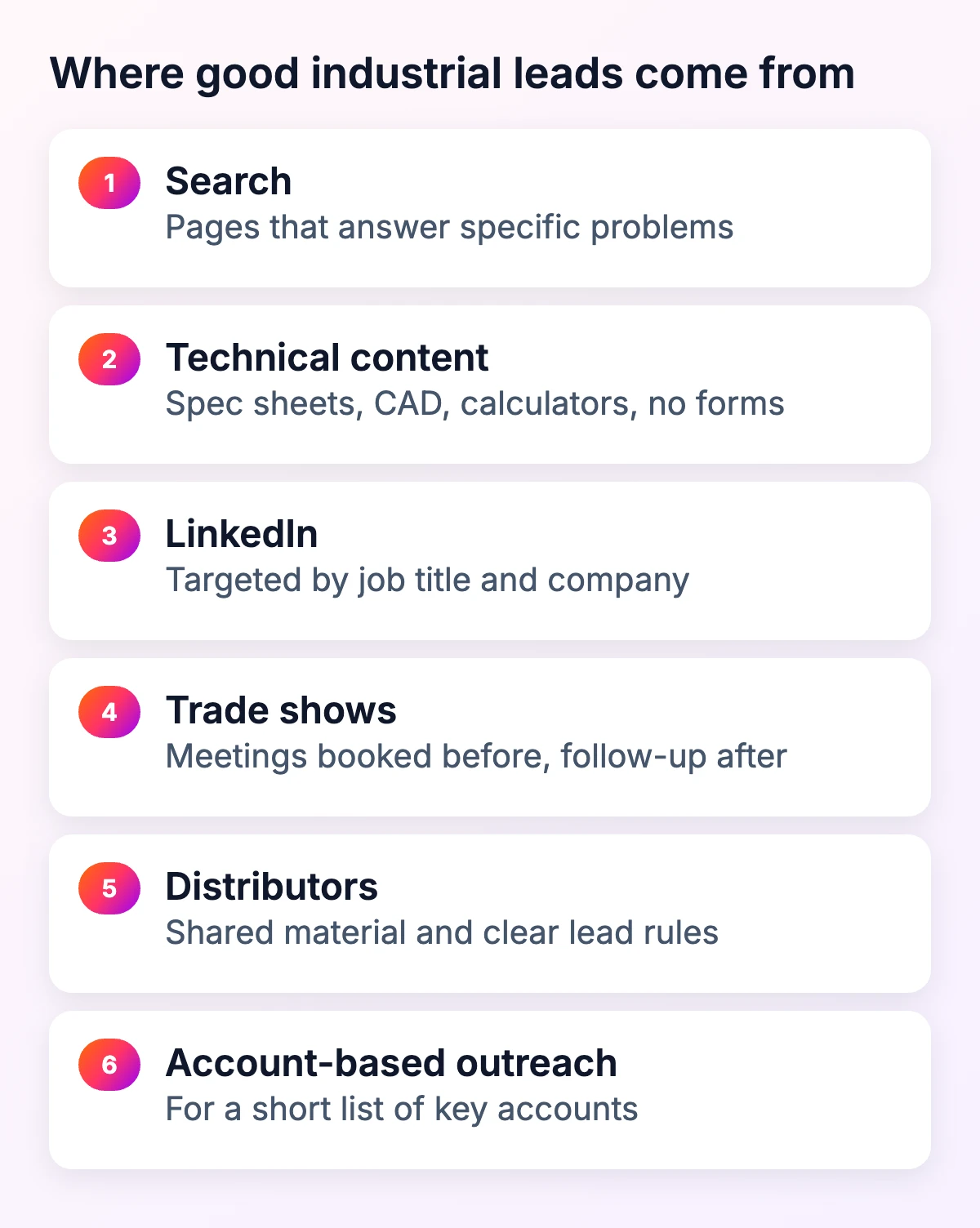
Where good industrial leads come from
Search: answering specific problems
Engineers search for problems and specs, not for suppliers. “Hygienic conveyor for bakery”, “reduce CIP cleaning time”, “high-pressure processing equipment supplier”. If you have a clear page answering each of those, you’ll attract a small number of very relevant people, month after month. This is the slowest channel to build and usually the cheapest per qualified lead once it’s running.
Technical content people actually want
Spec sheets, CAD files, application notes, ROI or TCO calculators. These are the things buyers need to build a case internally. They’re also where a lot of manufacturers make it unnecessarily hard.
In most cases: don’t gate your spec sheets. If I’m already seriously considering your product, making me hand over my details just to see basic technical information is unnecessary friction. Gate content when there’s a real value exchange, not just because you want an email address.
Lot, Lum Collective
You’ll get fewer form fills. You’ll get better ones, because the people who do get in touch are asking for something real: a quote, a sample, a conversation. And you can still see which companies are reading your technical pages through your analytics.
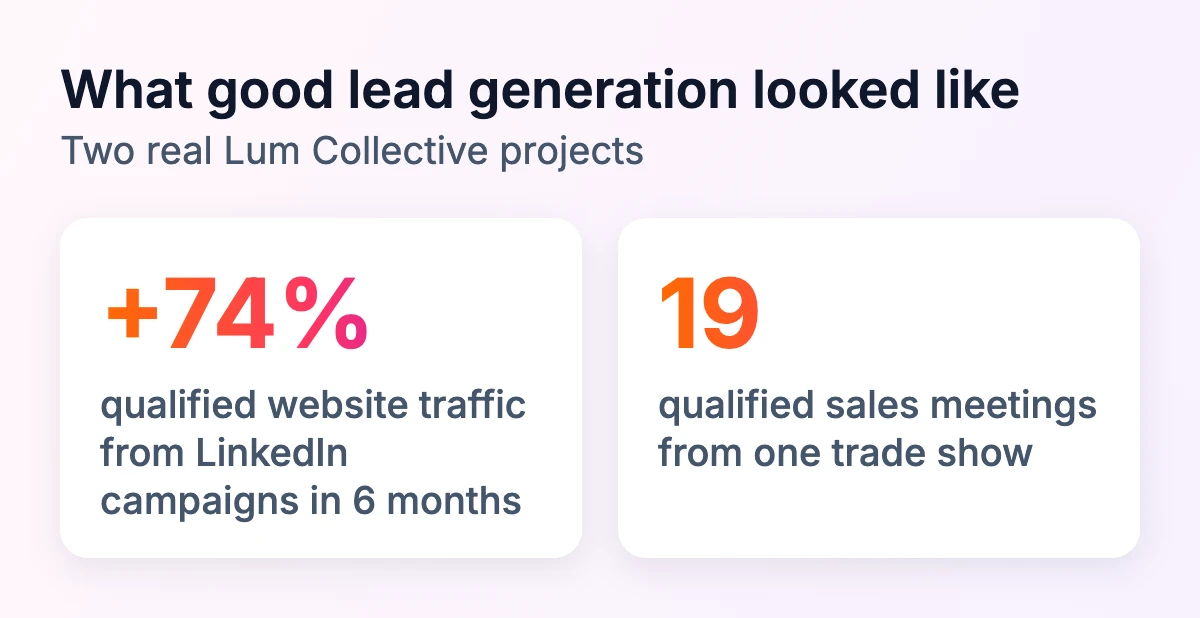
LinkedIn is useful because you can target by job title, industry and company, which suits small, well-defined audiences. It works best as a combination: real people from your company posting about what they see in the field, plus ads aimed at specific roles at your target accounts. For one B2B food tech company, campaigns aimed at R&D and product development teams brought in 74% more qualified website traffic in six months (here’s the case study).
Trade shows
Still one of the best sources of serious leads in manufacturing, as long as you plan beyond the stand. Book meetings before the show, qualify on the stand, and follow up within days. For a radio and private LTE integrator, that approach turned one show into 19 qualified sales meetings (case study). The full playbook is in following up on trade show leads.
Distributors and partners
If you sell through distributors, a lot of your leads will appear on their side, not yours. Make it easy for them: give them product content, campaign material and a simple way to pass leads back and forth. Agree upfront how leads are shared, so nobody feels the other side is stealing deals.
Targeted outreach and account-based marketing
For a short list of really important target companies, waiting for them to find you isn’t enough. Account-based marketing means picking those accounts with sales, and then aiming ads, content and personal outreach at the people in them. It’s more work per account, but in a market with a few hundred real prospects, that’s often exactly the right trade-off.
Make it easy to raise your hand
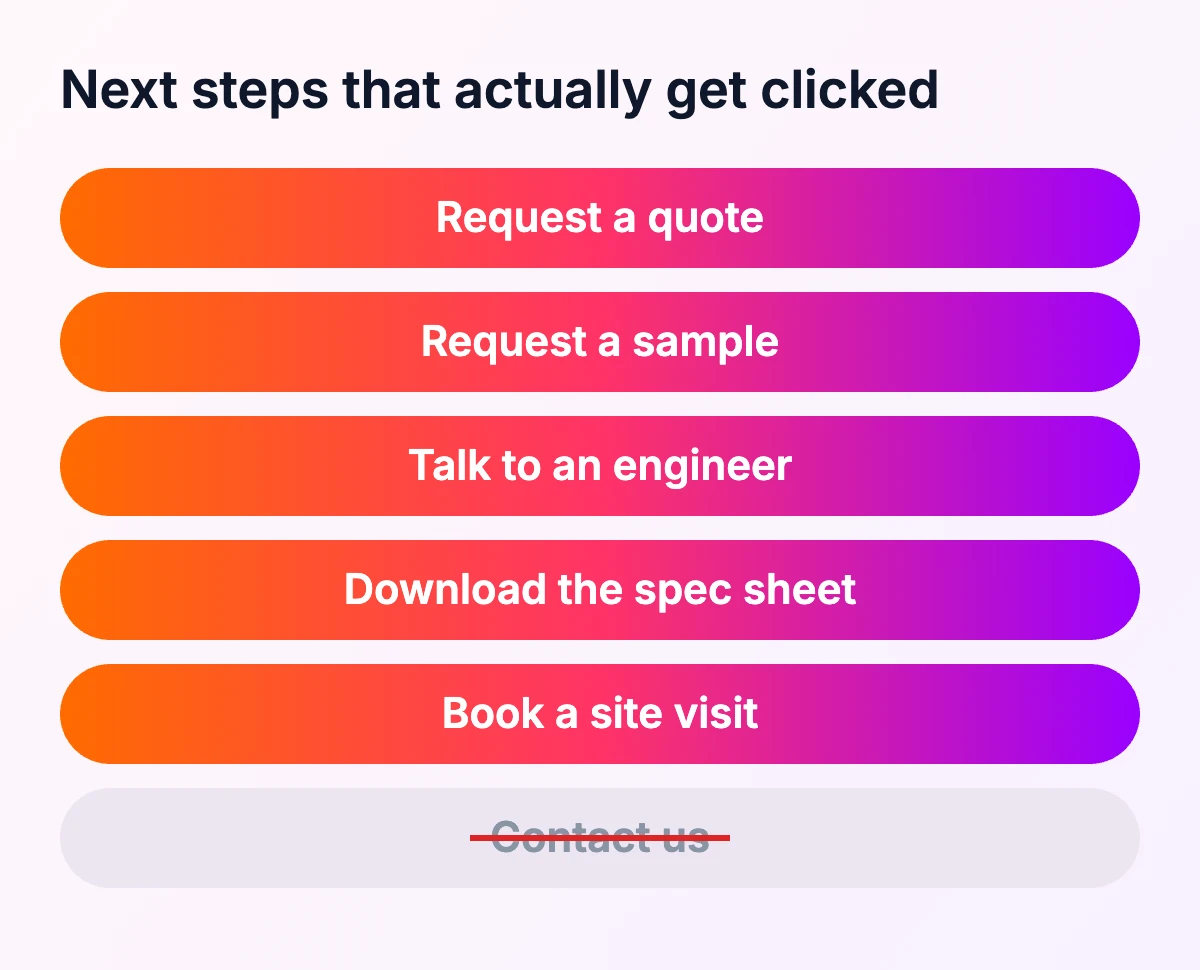
Once the right people are on your website, the question is whether they can take a next step that feels natural. “Contact us” is not a next step. These usually work better: (The bigger system behind this is in inbound marketing for manufacturers.)
- Request a quote (with as few fields as you can live with)
- Request a sample or a trial
- Talk to an engineer, not “a sales representative”
- Book a demo or a site visit
- A phone number and an actual name, especially for smaller markets
And keep forms short. Name, company, email and one open question is often enough. You can ask the rest on the phone.
Qualify and score your leads
Not every lead deserves the same attention. A simple scoring model helps marketing and sales agree on which ones go straight to a salesperson. Here’s a rough example, just to show the idea (your own signals and points will be different):
| Signal | Points |
|---|---|
| Company works in one of your target applications | +20 |
| Relevant job title (engineering, QA, operations, procurement) | +10 |
| Located in a region you serve | +10 |
| Visited application pages or spec sheets several times | +10 |
| Downloaded technical documents | +10 |
| Requested a quote, sample or call with an engineer | +40 |
| Student, supplier or competitor | −50 |
Anything above, say, 50 points goes to sales the same day. Everything else gets nurtured with useful content until it scores higher, or doesn’t. Review the model every few months with sales and adjust it to what actually turned into business.
Follow up fast, and close the loop
Speed matters more than polish. Research published in Harvard Business Review found that companies contacting leads within an hour were far more likely to qualify them than companies that waited. In manufacturing, “within the hour” isn’t always realistic, but the same day is.
Then close the loop. Once a month, look at which leads became opportunities and orders, and which channels they came from. I’ve seen a company come back from a trade show thrilled with more than 200 leads, and once the list was cleaned up only a small share were relevant prospects. That’s not a failure, it’s information. Use it to adjust where you spend your time.
Getting leads but not sure which ones matter? We help B2B manufacturers set up lead generation that sales actually trusts, from targeting to scoring to reporting. Let’s talk.
How to measure manufacturing lead generation
A few numbers tell you most of what you need to know: cost per qualified lead by channel, the percentage of leads that become opportunities, pipeline value by source, and the time from first contact to order. Website traffic and form fills are useful signals, but they’re not the goal. If you want help connecting your website, forms and CRM so you can actually see this, that’s what our analytics and reporting work is for.
Mistakes I see a lot
- Celebrating lead volume while sales ignores most of the leads.
- Gating every PDF and then wondering why the leads are low quality.
- Treating a trade show badge scan as a lead.
- No agreed definition of a qualified lead between marketing and sales.
- Leads sitting in a shared inbox for a week before anyone replies.
Where to start
If you only do three things this quarter: agree with sales on what a good lead looks like, make your spec sheets and technical pages easy to reach, and set a same-day follow-up rule. Then build from there. For the bigger picture, have a look at our industrial marketing strategy in 8 steps and our guide to marketing for manufacturing companies.
Frequently asked questions
It’s the process of attracting potential buyers for industrial products and getting them to show interest, for example by requesting a quote, a sample or a call with an engineer. In manufacturing it focuses on a small number of well-targeted, qualified leads rather than large volumes.
Search and technical content, LinkedIn, trade shows with proper follow-up, distributors and targeted account-based outreach. Most manufacturers do best by focusing on three or four of these rather than trying everything.
Usually not. Gating basic technical information mostly creates friction for serious buyers. Keep spec sheets easy to access and ask for contact details when someone requests a quote, sample or call.
Agree with sales on fit criteria such as application, job title, company size and region, add behaviour signals like technical downloads or quote requests, and use a simple scoring model. High-scoring leads go to sales the same day; the rest are nurtured.
Trade show follow-up, outreach and paid campaigns can produce conversations within weeks. Search and content usually take six to twelve months to build up, but tend to bring the lowest cost per qualified lead over time.