

The quiet problem most hotels don’t talk about
When we speak with hotel owners, boutique hospitality teams or marketing managers, the conversation rarely starts with SEO.
It usually starts with something more emotional.
“We have a beautiful property, but people don’t find us directly.”
“We get bookings, but too many come through OTAs.”
“Our guests love the experience once they arrive, but online we look like every other hotel.”
That last sentence matters.
Because hotel SEO is about making sure the right guest understands why your hotel is worth choosing before they are pulled into a comparison table, a discounted OTA listing or a generic “best hotels in…” article.
“For hotels, SEO is not only about being visible. It is about being visible before the guest has already been trained to compare you on price.” – Charlotte, Lum Collective
For hotels, visibility is not a vanity metric. It is commercial independence.
The more your hotel depends on third-party platforms for discovery, the less control you have over your margin, guest relationship and brand story. OTAs are useful. They create demand, fill rooms and support visibility. But when they become the main way guests find and book you, your own website starts behaving like a brochure instead of a revenue channel.
What hotel SEO really means
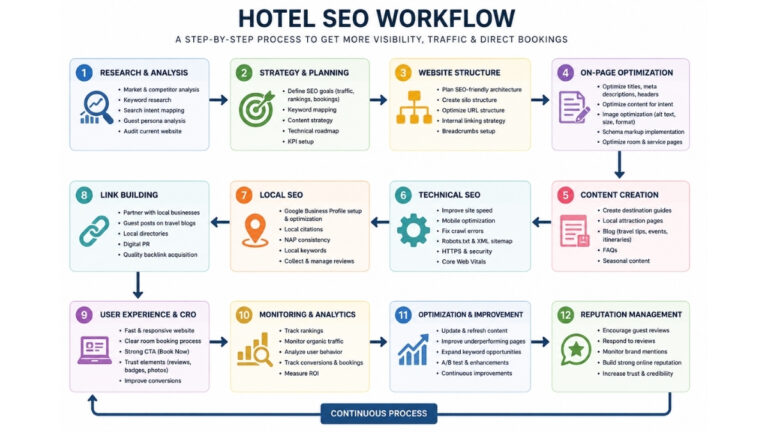
Hotel SEO is the process of improving your hotel’s visibility in search engines so potential guests can find your website when they are researching where to stay, what to do in a destination or which type of accommodation fits their trip.
But for hotels, SEO works differently than it does for many other industries.
A software company might rank for a problem. A hotel needs to rank across a whole travel journey.
Someone may search for “boutique hotel in Barcelona” one day, “best area to stay in Barcelona with kids” the next, and “hotel near Passeig de Gràcia with breakfast” a week later. The same guest can move from inspiration to comparison to booking across dozens of searches.
Good SEO for hotels makes sure your property appears in more of those moments.
Not only when someone already knows your name.
Not only when they are ready to book.
But also when they are still deciding what kind of trip they want.
“A hotel website should not only answer the final booking question. It should help shape the decision long before the guest clicks ‘reserve’.” – Charlotte, Lum Collective
This is why hotel SEO should never be reduced to adding keywords to room pages. It is a visibility system made up of technical SEO, local SEO, content, conversion, structured data, digital PR and brand signals.
Search remains one of the strongest channels in travel planning. Research from hospitality and travel marketing sources consistently shows that search engines play a dominant role in hotel discovery and direct booking journeys. Even if the exact percentages differ by market and property type, the direction is clear: if your hotel is not visible in search, a large part of demand is being captured somewhere else.

Why hotels lose direct bookings before guests even reach the website
A hotel can have a beautiful website and still lose the booking.
We have seen this happen often. The homepage looks elegant. The photography is strong. The rooms are well presented. But when you search for the hotel’s own destination, neighbourhood or experience, the website is nowhere to be found.
Instead, the guest sees OTAs, listicles, Google Maps results, review platforms, travel blogs and competitors.
By the time they reach the hotel website, if they reach it at all, they have already been trained to compare by price.
That is a real SEO problem for hotels. It not only means that the website does not rank. It is that the hotel enters the guest journey too late.
And when a hotel enters too late, the conversation has already changed from:
“This looks like the perfect place for us.”
to:
“Can I get this cheaper somewhere else?”
That shift costs money.
OTA commissions are often discussed in the range of 15% to 25%, and some industry sources cite even higher ranges depending on platform, market and commercial agreement. That means every direct booking gained through organic visibility can have a direct impact on profitability, not just traffic.
“Every direct booking is not just a booking. It is a guest relationship you get to own from the beginning.” – Charlotte, Lum Collective
This is why SEO for hotels should always be connected to commercial goals. More organic traffic is useful, but only if that traffic helps the hotel reduce dependency, improve margins and build a stronger relationship with guests.
Real-world example
Why one boutique hotel was missing direct bookings
We recently reviewed a boutique hotel website that looked beautiful, but was barely visible for non-branded searches. Guests could find the hotel if they already knew the name, but not when searching for things like where to stay, neighbourhood tips or boutique hotels in the area.
The issue was not the design. The room pages were very thin, the location content was limited, and the website gave Google very little context about why this hotel was relevant for specific types of travellers.
Our first recommendation was to strengthen the accommodation pages, add useful local content, improve internal links and make the hotel’s unique selling points clearer throughout the site.
The lesson: a beautiful hotel website still needs enough substance for search engines and guests to understand why it deserves to be found.
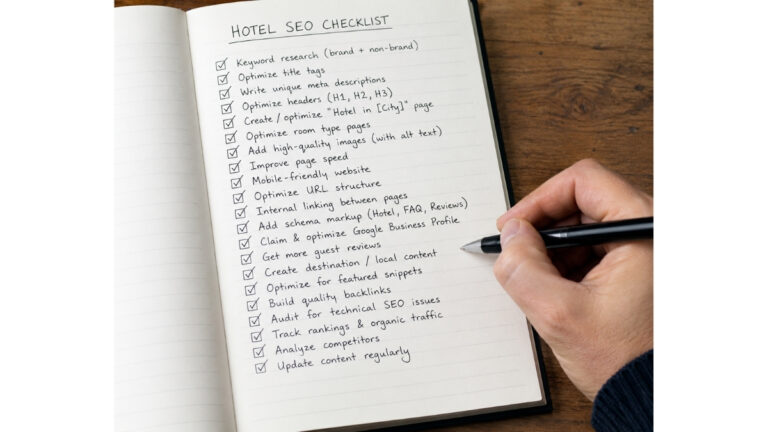
The mistake: treating hotel SEO like a checklist
Many hotels have “done SEO” at some point.
They have installed a plugin. Added meta descriptions, written a few destination blogs. Maybe even created a page for “hotel in [city]”.
But SEO does not work when it is treated as a one-time website task.
Especially not in hospitality.
Hotels operate in a search environment where Google results are crowded with maps, ads, OTAs, review snippets, travel guides, images, videos and AI-generated answers. Research into search results has shown that SERP features can significantly influence organic click-through behaviour, meaning ranking position alone does not tell the full story anymore.
For hotels, this means one thing: you are not only competing for rankings. You are competing for attention inside a very visual, very fragmented search experience.
A basic SEO checklist will not solve that.
A stronger hotel SEO strategy starts with three questions:
- What does the guest need to believe before they book directly?
- Which search moments influence that belief?
- Does our website answer those moments better than OTAs, competitors and generic travel blogs?
If the answer to the third question is no, then the hotel does not have an SEO problem only. It has a positioning problem showing up in search.
When a hotel tells us they have an SEO problem we often see something deeper: their online presence does not reflect the experience guests actually have when they arrive.
"One thing we see repeatedly is hotels investing thousands into beautiful photography and paid advertising while treating organic visibility as an afterthought."
The reality is that guests often discover a hotel weeks or months before they book. If you're not visible during that research phase, you're missing opportunities long before someone reaches your booking engine.
The hotel SEO strategy we would build first
If we were sitting with a hotel team over coffee, we would not start by opening a keyword tool.
We would start by asking what kind of guest they actually want more of.
Because ranking for “hotel in Barcelona” or “hotel in Amsterdam” sounds attractive, but those searches are broad, competitive and often dominated by large platforms. For many independent hotels, boutique hotels and hospitality groups, the better opportunity sits in more specific intent.
The guest looking for a “romantic boutique hotel in Barcelona with a rooftop” is different from the guest searching for a “cheap hotel near the airport”. The family searching “where to stay in Barcelona with a toddler” is different from the business traveller searching “hotel near a conference centre with parking”.
Hotel SEO becomes much more powerful when it is built around guest intent instead of generic destination keywords.
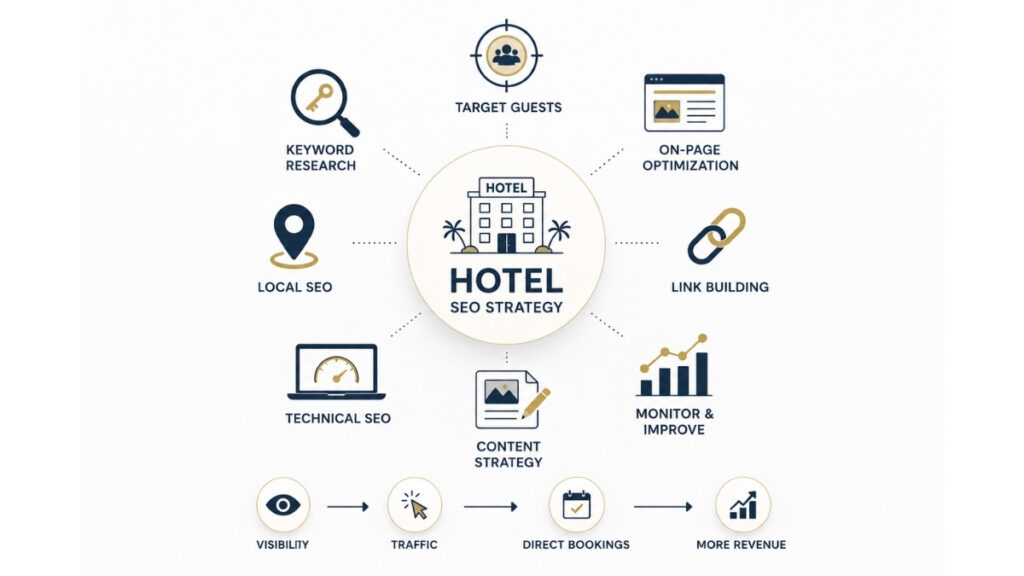
A strong first SEO layer usually includes:
- Commercial pages that are clear, indexable and optimised: homepage, rooms, suites, offers, restaurant, spa, meetings, weddings and location pages.
- Local visibility through Google Business Profile, local landing pages, reviews, map consistency and destination relevance.
- Experience-led content that answers real travel questions before guests are ready to book.
- Technical foundations such as speed, mobile usability, crawlability, structured data and clean indexation.
- Conversion signals that make direct booking feel safer, easier and more valuable than booking elsewhere.
That last point is often missed.
SEO can bring the guest to the website. But if the booking engine is slow, the direct benefits are unclear or the room pages feel less trustworthy than an OTA listing, the booking can still disappear.
Hotel SEO and conversion should not be separated.
“SEO gets people to the door. But the website still has to make them feel confident enough to book directly.” – Charlotte, Lum Collective

Content that actually helps hotels rank
Most hotel blogs fail because they are written for keywords, not for travellers.
You can feel it immediately.
“Top 10 things to do in [city]”
“Best restaurants near [hotel]”
“Why visit [destination] this summer”
There is nothing wrong with these topics. The problem is that most of them say the same thing as every other hotel blog, tourist board and travel website.
Hotel content should feel closer to a concierge conversation than a keyword exercise.
A good hotel blog should make the reader think:
“They understand the kind of trip I want.”
That is where originality comes from.
Instead of writing another generic destination guide, a boutique hotel could create content around very specific guest situations:
- Where to stay in the city if you want calm mornings and good restaurants within walking distance
- How to plan a slow weekend in the neighbourhood without rushing between tourist attractions
- What guests usually underestimate when booking a hotel in this part of the city
- The best room type for couples, families, remote workers or first-time visitors
- A local’s version of the destination, written from the hotel’s actual point of view
This kind of content does two things at once. It improves hotel visibility for long-tail searches and gives the guest a reason to trust the hotel’s perspective.
“The best hotel content feels like advice from someone who knows the place, not copy written to satisfy a keyword.”
– Charlotte, Lum Collective
That trust matters even more as search changes.
Recent research analysing 1,357 AI search citations across hotel queries found that experiential searches drew 55.9% of citations from non-OTA sources, compared with 30.8% for transactional searches, suggesting hotels have a stronger opportunity to influence discovery through rich, experience-led content rather than purely booking-focused pages.
"Most hotels don't need more content. They need more useful content."
We regularly see hotels publishing articles that nobody is searching for while overlooking the questions travellers are already asking.
A guide about nearby attractions, transport options, local events or the best neighbourhoods to stay in will often generate far more visibility than another generic hotel update or company news article.
Local SEO: where hotel visibility becomes physical
For hotels, local SEO is not optional.
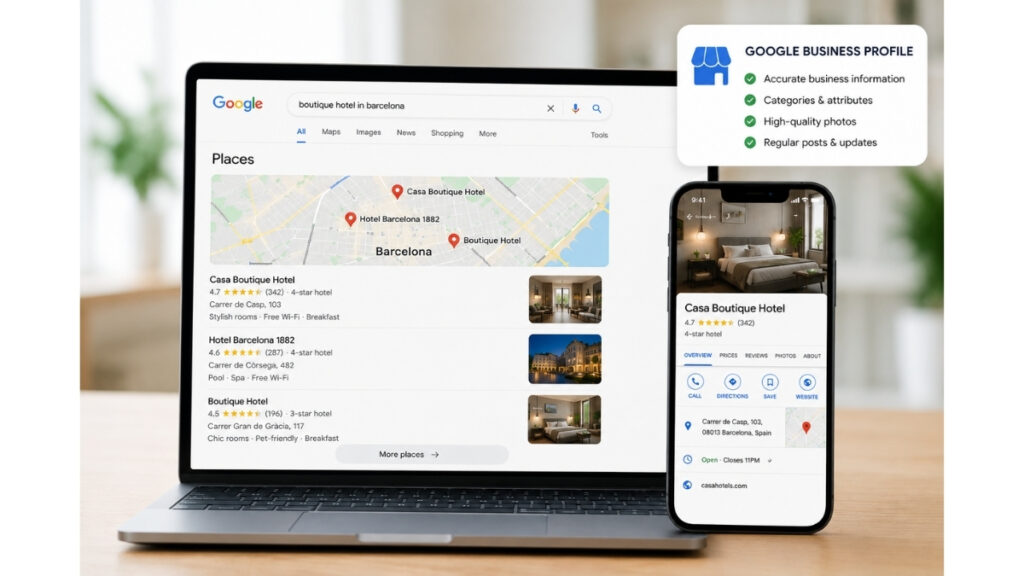
A guest may discover you through an article, but they will often validate the decision through Google Maps, reviews, photos, location signals and nearby landmarks.
This is where hotel visibility becomes physical.
Your Google Business Profile, address consistency, review quality, image freshness and local relevance all influence how trustworthy your property feels before someone clicks through.
And for hotels, local SEO should go beyond “near me”.
It should connect your property to the real reasons people choose that area.
A hotel near a convention centre should not only mention the convention centre. It should explain walking distance, transport, breakfast timing, business facilities and what guests can expect before and after the event.
A boutique hotel in a cultural neighbourhood should not only list museums. It should explain the rhythm of the area, who it suits, what kind of stay it creates and why the location is part of the experience.
A family-friendly hotel should not only say “family rooms available”. It should answer the questions parents actually have: stroller access, nearby playgrounds, quiet rooms, breakfast options, lifts, baths, connecting rooms and flexible check-in.
This is SEO for hotels at its best: useful, specific and commercially relevant.
“Local SEO is not about stuffing landmarks onto a page. It is about showing why your location genuinely makes the stay better.” – Charlotte, Lum Collective
Real-world example
How a hotel was invisible in Google Maps despite having great reviews
We once reviewed a hotel that had excellent guest reviews and a strong reputation locally, yet it barely appeared for searches such as "boutique hotel near city centre" or "hotel with rooftop bar".
The Google Business Profile was incomplete. Room categories were missing, photos had not been updated in years, and there was very little information about nearby attractions or amenities.
After optimising the profile, improving location signals on the website and creating content around local landmarks and visitor interests, the hotel's visibility in local search improved significantly.
The lesson: many hotels focus exclusively on their website, while some of the most valuable visibility opportunities start inside Google Maps.

Technical SEO: the invisible layer that protects bookings
Technical SEO is not glamorous, but it protects revenue.
If Google cannot crawl your important pages properly, if old URLs create indexation noise, if your booking engine blocks key content, if images are too heavy or if multilingual pages are poorly implemented, your hotel can lose visibility without noticing immediately.
This is especially common after website redesigns.
A hotel launches a new site. The design looks better. Photography has improved. The brand feels more premium. But rankings drop because redirects were missed, page structures changed, metadata was removed or important content became harder for Google to understand.
Technical SEO should always be part of a redesign, not something added after launch.
The basics matter:
- clean URL structure
- fast mobile performance
- correct redirects
- indexable room and offer pages
- optimised images
- structured data
- multilingual hreflang setup where relevant
- XML sitemap and robots.txt checks
- no accidental no-index tags
- clear internal linking between destination, room and offer pages
This is not about pleasing Google for the sake of it. It is about making sure your most profitable pages can be found, understood and trusted.
“A hotel redesign can look beautiful and still damage revenue if SEO is brought in too late.” – Charlotte, Lum Collective
We often find bigger gains in technical fixes than in publishing more content.
Many hotels focus on writing new blog posts while overlooking issues such as slow loading times, broken internal links, duplicate pages and poor mobile experiences.
In many audits, fixing these technical foundations delivers results faster than months of additional content production.

Why direct booking SEO is also brand work
One thing we believe strongly: hotels should stop thinking of SEO as a traffic channel only.
SEO is also brand work.
Every search result says something about your hotel. Your title tags, meta descriptions, review snippets, images, FAQs, destination content and Google Business Profile all shape the guest’s perception before they ever arrive on your website.
If those signals are generic, your hotel feels generic.
If those signals are specific, confident and useful, your hotel starts building preference earlier in the journey.
This matters because AI search is changing how people discover travel options. Search engines and AI tools are increasingly summarising, comparing and recommending instead of simply listing links. Industry commentary around generative and agentic search points in the same direction: brands need consistent, trustworthy signals across their website, reviews, media, content and external mentions to remain visible in AI-driven discovery.
For hotels, that means your website cannot be the only place where your story exists.
Your SEO strategy should connect with PR, reviews, social proof, local partnerships, destination content and guest experience. Search visibility is becoming a reflection of your whole digital footprint.
“If your hotel has a strong experience but a weak digital footprint, search engines will not understand the value guests feel in real life.” – Charlotte, Lum Collective
What we would measure
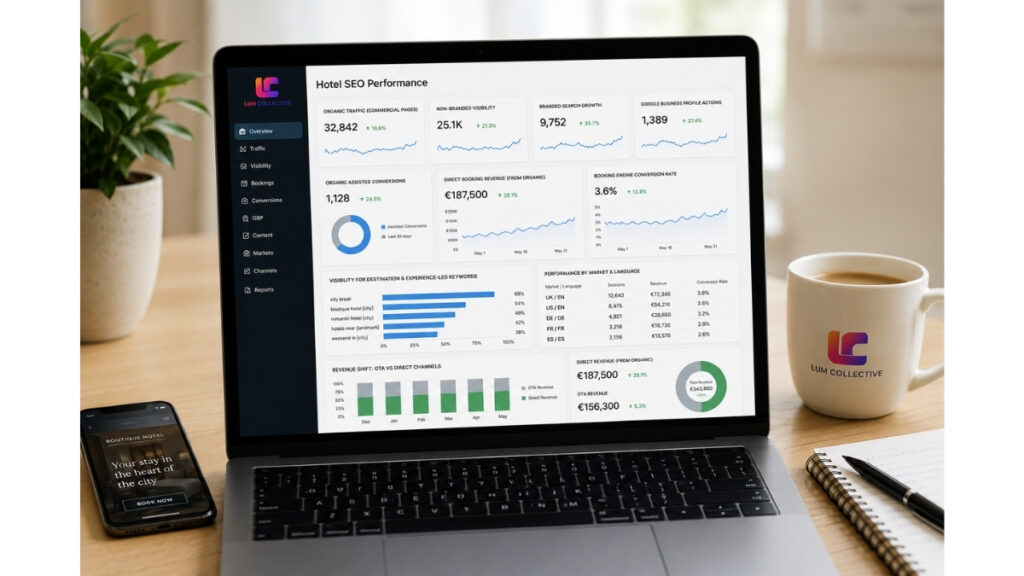
Hotel SEO should not be judged only by rankings. Rankings are useful, but they do not tell the whole commercial story.
A hotel can rank higher and still not increase bookings if the wrong pages are ranking, the booking path is weak or the traffic is too early in the journey.
For hospitality SEO, we would look at:
- organic traffic to commercial pages
- non-branded organic visibility
- branded search growth
- Google Business Profile actions
- organic assisted conversions
- direct booking revenue from organic search
- booking engine conversion rate
- visibility for destination and experience-led keywords
- performance by market and language
- revenue shift between OTA and direct channels
The goal is not simply more traffic.
The goal is better demand.
More qualified visitors. More direct bookings. More control over the guest relationship. Less dependence on rented visibility.
“If SEO does not connect to bookings, margin or guest quality, we are measuring the wrong thing.” – Charlotte, Lum Collective
A more personal way to think about hotel SEO
If Charlotte were speaking to a hotel founder directly, she would probably say this:
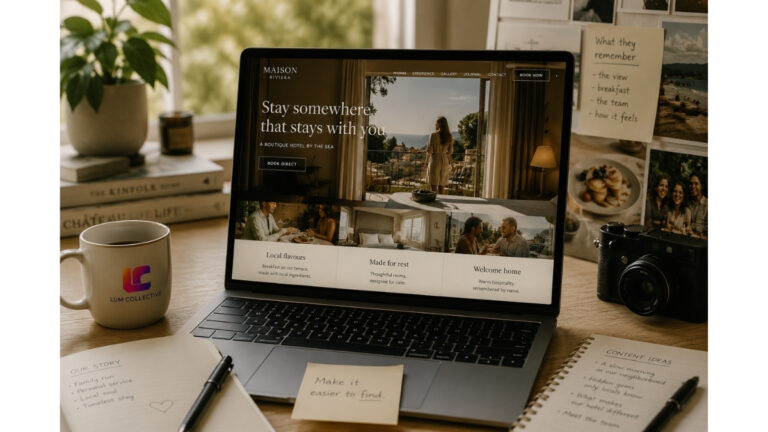
“Your hotel already has a story. It has a reason people come back. It has details guests remember. Maybe it is the breakfast. Maybe it is the view. Maybe it is the way your team welcomes people by name. SEO should not flatten that. It should make it easier to find.” – Charlotte, Lum Collective
The best hotel SEO does not turn your website into a keyword machine. It turns your real experience into searchable, structured and commercially useful content.
That is the difference between ranking and being chosen.
Visibility is rarely a traffic problem.
After more than eight years working in SEO, I've noticed that most hotels don't struggle because there isn't enough demand.
They struggle because they're invisible during the moments that matter most. Travellers are researching destinations, comparing neighbourhoods, looking for experiences and asking AI tools for recommendations long before they're ready to book.
The hotels that consistently appear throughout that journey are the ones that generate more direct bookings and reduce their dependence on OTAs.
That's why we built Lum Collective. To help hospitality brands become visible where modern travellers are actually looking.
How Lum Collective helps hotels with SEO
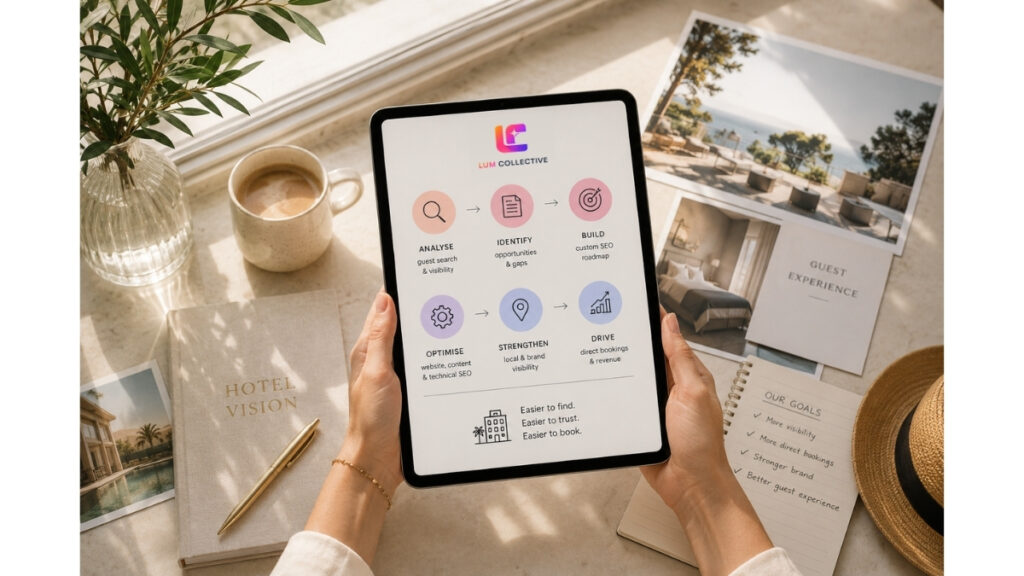
At Lum Collective, we help hospitality brands build SEO strategies that connect visibility with bookings.
That means we look beyond keywords. We analyse how guests search, where your hotel appears, where OTAs are capturing demand, how your website converts and what content is missing from the journey.
Then we build a practical SEO roadmap around your hotel’s real commercial goals.
For some hotels, that means improving technical SEO before a redesign. For others, it means building destination content, strengthening local visibility, optimising room pages or creating a stronger direct booking strategy.
The common thread is simple: we help hotels become easier to find, easier to trust and easier to book directly.
“Our job is not to make hotels sound like everyone else online. It is to translate what makes them worth choosing into a digital strategy that search engines and guests can both understand.” – Charlotte, Lum Collective
If you want to understand where your hotel is losing visibility, we can help you map the opportunity.
Book a strategy call with Lum Collective and let’s look at how SEO can increase your hotel’s direct bookings.